



Condenser vs OEM Replacement: What Really Affects Service Life
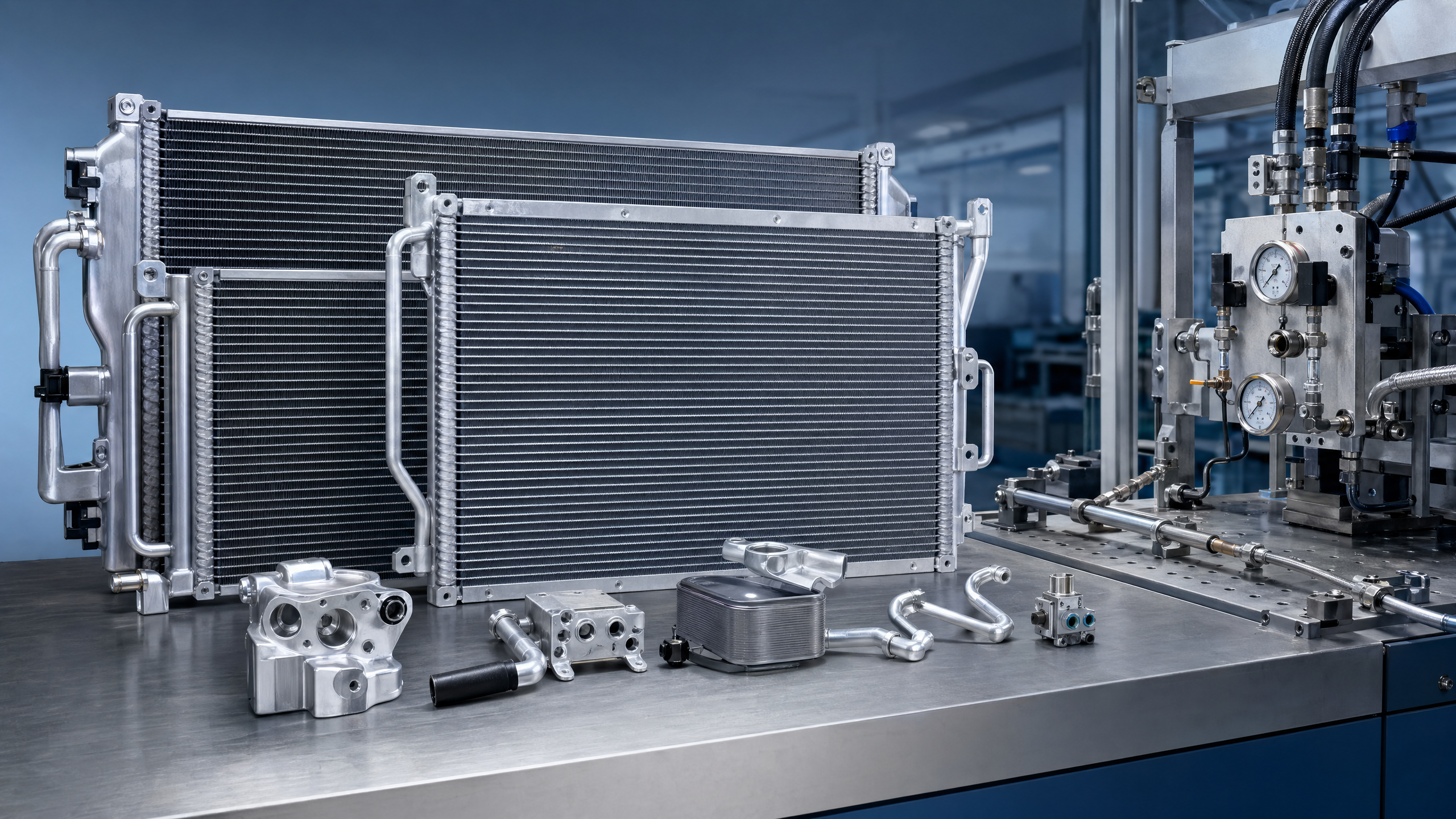
When evaluating a Condenser, service life is rarely determined by price alone. For technical assessors, the real difference between an OEM replacement and other options lies in material quality, brazing stability, corrosion resistance, thermal performance, and manufacturing consistency. Understanding these factors helps reduce downtime, control lifecycle cost, and ensure reliable operation in demanding heavy-duty and new energy applications.
What technical assessors are really trying to determine
Most searches around “Condenser vs OEM replacement” are not simply about whether a lower-cost part can fit and function. The deeper question is whether the replacement will deliver stable performance over time under real operating conditions. Technical evaluation teams usually need to judge risk: risk of early leakage, reduced heat exchange efficiency, accelerated corrosion, customer complaints, warranty returns, and unplanned maintenance intervals.
That is why service life should be assessed as a systems issue rather than a catalog comparison. A Condenser may appear similar in dimensions, mounting points, and nominal capacity, yet perform very differently after months of vibration, thermal cycling, road salt exposure, or high-pressure operation. The visible part of the product rarely tells the full story. The durability outcome is often decided by details in metallurgy, process control, tube design, fin bonding, and cleanliness during production.
For technical assessors in heavy-duty, commercial vehicle, and new energy sectors, the practical goal is straightforward: identify which factors are truly predictive of long-term field reliability. The best evaluation method is not asking whether a part is labeled OEM replacement, but whether its design and manufacturing discipline can consistently support OEM-level life under the intended duty cycle.
OEM replacement does not automatically mean OEM-level service life
One of the most common misunderstandings in the market is that “OEM replacement” is a performance category. In reality, it is often a commercial description. It may mean the part is designed to replace an original unit in terms of fitment, but that does not guarantee equivalent material thickness, alloy formulation, braze integrity, or corrosion resistance. For service life analysis, those differences matter far more than labeling.
An authentic OEM-supplied component is generally developed around validated test standards, traceable raw materials, controlled production windows, and long-cycle durability targets. A non-OEM replacement may still perform very well, but only if the manufacturer applies similar engineering discipline. If it does not, the service life gap may not show in the first weeks of use. It usually appears later as slow refrigerant leakage, reduced cooling effectiveness, fin deterioration, or structural cracking at joints and headers.
This is why technical assessment should focus on evidence, not terminology. Ask for test data, process capability, validation records, coating specifications, pressure endurance results, and quality escape controls. A replacement Condenser can absolutely be a sound choice, but only if its service life drivers are clearly demonstrated rather than assumed.
The biggest factors that really affect Condenser service life
The first major factor is material quality. Aluminum alloy selection affects corrosion behavior, pressure tolerance, thermal conductivity, and braze compatibility. If the tube, fin, header, and side plate materials are not properly matched, the Condenser may be more vulnerable to galvanic attack, weakened joints, or performance loss over time. Material thickness also matters. If wall thickness is reduced too aggressively to cut cost, resistance to vibration, impact, and internal pressure cycling can decline sharply.
The second factor is brazing quality. Many failures that appear to be random leaks are actually rooted in unstable brazing. Inconsistent furnace atmosphere, poor flux control, contamination, or uneven temperature distribution can lead to weak joints, voids, brittle areas, or insufficient bonding between tubes and headers. These defects may pass a basic leak test at shipment, yet still fail prematurely in service after repeated heating and cooling cycles.
The third factor is corrosion resistance. Road salt, moisture, industrial pollution, and trapped debris can all shorten the life of a Condenser. Protective coatings, surface treatments, drainage design, and fin geometry can influence how quickly corrosion develops. In some climates, corrosion resistance becomes the dominant life factor, outweighing even nominal cooling capacity. A technically sound evaluation always considers the actual environmental exposure profile, not just laboratory specifications.
Thermal performance affects durability more than many buyers expect
Service life is not only about whether the Condenser leaks. It is also about whether it can maintain stable heat rejection over time without forcing the broader thermal system to operate under stress. A poorly designed or marginally sized Condenser may still function, but if it drives higher system pressure or less efficient heat transfer, that extra load can accelerate wear across the air conditioning loop and reduce overall operating stability.
Fin density, air-side design, tube geometry, refrigerant flow path, and internal cleanliness all influence thermal performance. If refrigerant distribution is uneven or pressure drop is excessive, some sections may work harder than others. That can create localized stress, poor cooling consistency, and higher compressor burden. In high-load applications, especially commercial vehicles or electrified thermal management systems, these design inefficiencies can translate directly into shorter effective life.
Technical assessors should therefore treat thermal performance data as a durability indicator, not only a comfort or efficiency metric. A Condenser that consistently maintains heat exchange efficiency under realistic airflow and ambient conditions is usually better positioned to achieve longer service life than a part that only meets nominal performance in ideal test conditions.
Manufacturing consistency is often the hidden separator
In many sourcing decisions, the most important difference is not between one design and another, but between one stable manufacturing system and another unstable one. A sample can perform well, yet mass production quality may drift if the factory lacks process discipline. For technical evaluation, consistency in furnace control, leak testing, dimensional accuracy, cleaning, packaging, and traceability is just as important as product design.
Look closely at whether the manufacturer has repeatable standards for raw material incoming inspection, core assembly alignment, braze oven control, pressure testing, and final inspection. Even a well-engineered Condenser can suffer shortened service life if production variation causes occasional weak joints, bent fins, contamination inside passages, or inconsistent coating coverage. Those small process deviations can create a high field-failure cost over time.
This is particularly relevant for buyers managing multiple vehicle platforms or export markets. A supplier with reliable process capability can help reduce not only claims and replacements, but also the engineering workload tied to recurring validation issues. In life-cycle terms, manufacturing consistency often has more value than a small difference in unit price.
How to evaluate service life beyond fitment and initial leak testing
A practical technical review should begin with a structured checklist. First, confirm design fitment and compatibility, including mounting points, flow path, dimensions, and pressure requirements. Then move quickly into durability evidence: pressure cycling data, burst pressure margin, corrosion testing, thermal shock testing, vibration testing, and long-duration leak performance. A part that passes only static fitment review is not truly evaluated for service life.
Second, request process and material transparency. The supplier should be able to explain alloy selection, coating approach, braze process controls, cleanliness management, and final inspection methods. If the supplier cannot clearly describe how service life is engineered and protected in production, technical assessors should treat long-term reliability claims cautiously. Good factories usually welcome this level of scrutiny because it helps distinguish capability from commodity competition.
Third, compare total cost of ownership rather than purchase price. A lower-cost Condenser with a higher probability of early degradation can create much greater cost through labor, downtime, refrigerant loss, customer dissatisfaction, and repeat service events. For fleets, workshops, distributors, and OEM-adjacent buyers, the right decision is often the one that minimizes field disruption, not the one with the lowest invoice number.
Where replacement decisions become more complex in heavy-duty and new energy applications
In passenger vehicles with relatively moderate loads, a wide range of replacement products may appear acceptable at first. In heavy-duty or high-demand use cases, however, service life margins narrow quickly. Trucks, construction machinery, and high-thermal-load platforms expose heat exchangers to stronger vibration, broader temperature swings, contamination, and longer operating hours. Under these conditions, small manufacturing weaknesses become failure points much faster.
New energy applications add another layer of complexity. Thermal management in electrified systems often requires tighter performance consistency and stronger integration with overall cooling architecture. A Condenser or related heat exchanger that drifts from expected thermal behavior can affect not just cabin comfort but system efficiency and thermal stability. For this reason, technical assessors in newer platforms should place more weight on engineering validation and supplier capability than on basic interchangeability claims.
This broader perspective also explains why many professional buyers look beyond a single component and assess the supplier’s experience across thermal management products. For example, a manufacturer working on radiators, intercoolers, construction machinery radiators, and new energy radiator modules is often better positioned to understand heat transfer, durability tradeoffs, and production consistency across demanding applications. In some sourcing programs, related products such as Radiator for Benz can serve as useful reference points for evaluating a supplier’s engineering approach to engine cooling and thermal management.
Questions technical assessors should ask suppliers before approval
A strong supplier review should include very direct questions. What alloys are used in tubes, fins, and headers? What corrosion protection system is applied, and how was it validated? What are the pressure cycling and vibration test conditions? What percentage of products undergo leak testing, and at what pressure? How is furnace brazing consistency monitored? What traceability exists for raw material lots and production batches? The quality of answers often reveals more than brochures do.
It is also valuable to ask how the supplier handles failure analysis. If a field issue occurs, can they identify root cause through metallographic examination, braze section analysis, pressure-path review, and process traceability? Suppliers that can investigate failures scientifically tend to maintain stronger quality systems. They are also more likely to improve product life over time rather than simply replace failed parts and move on.
Finally, ask for evidence that the product is designed for the specific application environment. A universal claim is not enough if your operating profile includes long idle periods, dusty conditions, corrosive roads, or intensive thermal cycling. Even where products are marketed to meet or exceed OEM specifications, technical assessors should verify how that statement is supported in testing and process control. The same mindset applies across related categories, including cooling solutions for Mercedes-Benz passenger cars and commercial vehicles where thermal management expectations remain high.
A practical decision framework: when is a replacement Condenser the right choice?
A replacement Condenser is the right choice when its long-term reliability can be demonstrated with credible technical evidence, stable manufacturing controls, and application-matched performance. If it meets durability requirements, controls corrosion well, maintains heat rejection efficiency, and comes from a supplier with traceable process quality, it may offer excellent value. In this case, “replacement” is not a compromise. It is simply an alternative sourcing route backed by engineering proof.
It is the wrong choice when evaluation is based mainly on price, fitment, and initial visual quality. These criteria are too shallow for service life prediction. Technical assessors should be especially cautious when documentation is weak, validation language is vague, or supplier responses focus heavily on catalog breadth rather than production discipline. The cost savings from such purchases can disappear quickly after a few field failures.
For procurement teams working closely with engineers, the best practice is to build a scorecard that weights service-life drivers properly: materials, brazing, corrosion resistance, thermal performance, validation testing, and manufacturing consistency. This makes approval decisions more objective and helps align purchasing with lifecycle reliability goals rather than short-term cost pressure.
Conclusion
When comparing a Condenser with an OEM replacement, the real service life question is not who offers the lowest price or the closest visual match. It is who can prove reliable durability through materials, process control, corrosion protection, thermal performance, and production consistency. For technical assessors, those are the variables that most directly predict field life.
In practical terms, OEM replacement can be a strong option, but only when supported by evidence. The smartest evaluation approach is to move beyond labels and ask what the component is made from, how it is brazed, how it resists corrosion, how it performs under load, and how consistently it is manufactured. Those answers will tell you far more about service life than a product description ever will.
If the goal is lower downtime, better lifecycle cost control, and dependable operation in heavy-duty or new energy environments, then the right Condenser decision is a technical one first. Price matters, but service life is built by engineering, validated by testing, and protected by disciplined manufacturing.