



Condenser Leak Risks and Inspection Points
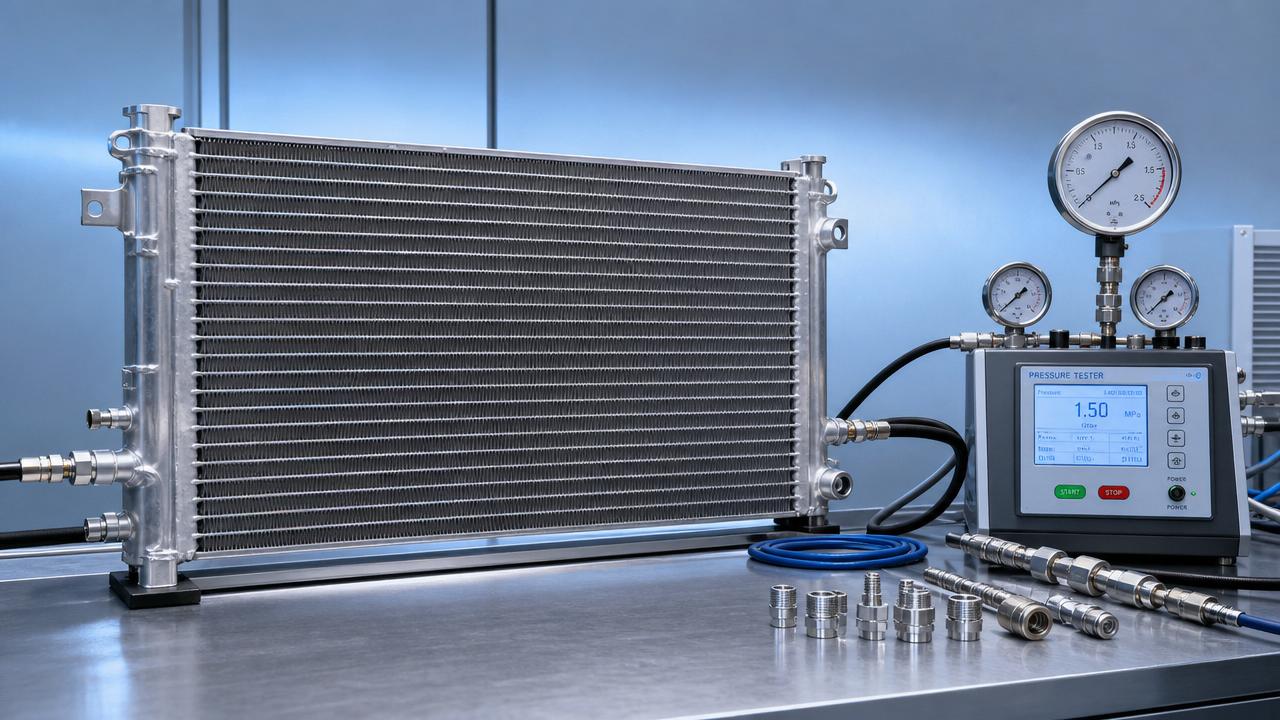
Condenser Leak Risks and Inspection Points in Evolving Thermal Systems
A Condenser leak is more than a minor component defect.
It can trigger cooling inefficiency, system pressure loss, corrosion, and safety risks across heavy trucks, construction machinery, and new energy thermal modules.
As thermal systems become more compact and pressure-sensitive, early Condenser inspection has become a key reliability requirement.
Leak detection now supports longer service life, lower downtime, and more stable performance under demanding operating conditions.
Thermal Component Risk Is Rising With System Complexity
The role of the Condenser is changing as vehicles and machinery carry higher thermal loads.
Traditional cooling layouts were often larger, simpler, and more tolerant of small performance losses.
Modern applications rely on tighter packaging, lighter materials, and higher heat exchange efficiency.
This shift increases sensitivity to small cracks, weak welds, blocked fins, and damaged sealing points.
A small Condenser leak may first appear as gradual cooling decline.
If ignored, it can develop into pressure imbalance, compressor stress, refrigerant loss, or contamination inside the thermal circuit.
For heavy-duty applications, these failures often happen under vibration, dust, high temperature, and long working cycles.
Trend Signals Showing Why Condenser Inspection Matters More
Several industry signals are making Condenser leak prevention more important than before.
First, new energy vehicles and hybrid systems need precise temperature control for batteries, motors, and electronic modules.
Second, construction machinery is operating in harsher locations, where impact damage and dirt accumulation are common.
Third, global spare parts demand is moving toward predictable quality and traceable inspection results.
These changes mean a Condenser is no longer judged only by fitment and basic appearance.
Its leakage resistance, brazing stability, corrosion protection, and pressure behavior are becoming central evaluation points.
Main Causes Behind Condenser Leak Formation
A Condenser leak usually develops from material stress, manufacturing weakness, installation error, or environmental attack.
The exact cause often depends on the application and operating cycle.
- Brazing defects may create weak points between tubes, headers, and fins.
- Stone impact can puncture thin tube walls during highway or site operation.
- Salt, moisture, and chemical exposure can accelerate aluminum corrosion.
- Improper mounting may create vibration fatigue near brackets and joints.
- Overpressure can damage internal passages or sealing surfaces.
- Poor handling can bend fins and reduce airflow efficiency.
These causes rarely stay isolated.
For example, a slightly bent Condenser may collect more dirt, run hotter, and suffer faster corrosion.
This combination can turn a small defect into a visible refrigerant leak.
Failure Indicators That Should Not Be Ignored
Early symptoms of a Condenser leak are sometimes subtle.
A system may still operate, but efficiency and safety margins can already be reduced.
Common warning signs include oily stains near joints, unusual pressure drops, weak cooling output, and abnormal compressor cycling.
Visible corrosion around tube ends also deserves attention.
In heavy trucks, a damaged Condenser can affect cab climate control and engine-area thermal balance.
In construction machinery, reduced heat exchange may increase operator discomfort and equipment stress during continuous work.
In new energy systems, unstable thermal control can influence battery and electronic module reliability.
A practical inspection plan should treat small leakage traces as early risk signals, not cosmetic issues.
Critical Condenser Inspection Points for Reliable Evaluation
A complete Condenser inspection should combine visual checks, pressure testing, dimensional review, and cleanliness assessment.
Relying on one method may miss hidden damage or slow leakage.
1. Tube, header, and brazing zone
The tube-to-header area is one of the most common Condenser leak zones.
Inspect for cracks, uneven brazing, discoloration, pinholes, and oil traces around welded joints.
2. Fins and airflow passages
Bent fins do not always cause leakage directly.
However, blocked airflow raises working temperature and may increase Condenser pressure stress over time.
3. Mounting brackets and vibration points
Loose or misaligned mounting can transfer vibration into the core.
Check bracket welds, rubber cushions, bolt holes, and contact areas for fatigue marks.
4. Inlet and outlet connections
Connection points must be checked for sealing surface damage and thread deformation.
A leak near fittings may be mistaken for a core failure.
5. Corrosion and surface coating
White oxidation, pitting, or coating loss can indicate long-term Condenser durability concerns.
Surface condition is especially important for coastal, mining, and winter road applications.
How Leak Risks Affect Different Business Links
Condenser leakage influences more than one maintenance event.
It affects production control, warehouse handling, installation accuracy, fleet uptime, and warranty analysis.
In production, weak brazing or poor cleanliness may create repeated defects.
In logistics, rough stacking can deform cores before installation.
In service, incorrect tightening or missing supports can shorten Condenser life.
This is why leak prevention should be viewed as a chain responsibility.
A similar principle applies to related thermal parts, including radiator modules and intercoolers.
For reference, solutions such as Radiator for TOYOTA show how thermal components must balance fitment, durability, and stable heat exchange.
Inspection Priorities for Heavy Trucks and Machinery
Heavy-duty environments require a more practical Condenser inspection standard.
The focus should move from simple appearance checks toward performance and risk confirmation.
- Confirm pressure retention under specified test conditions.
- Check all welded joints before and after vibration exposure.
- Inspect fin density, fin flatness, and airflow blockage.
- Review mounting points for deformation or missing support.
- Examine surface corrosion in areas exposed to water and salt.
- Verify packaging protection before shipment and storage.
These priorities help identify whether a Condenser defect comes from production, transport, installation, or field operation.
Clear cause analysis reduces repeated failure and improves future component selection.
Practical Testing Methods for Leak Confirmation
Different Condenser leak tests serve different purposes.
A strong inspection program usually combines several methods instead of depending on one result.
Testing records should include pressure level, holding time, ambient conditions, and failure location.
This information helps compare Condenser performance across batches and operating applications.
Manufacturing Quality Is Becoming a Stronger Differentiator
As leak tolerance becomes stricter, manufacturing quality is gaining more weight in component decisions.
Stable material control, accurate forming, clean brazing, and final pressure testing all influence Condenser reliability.
Liaocheng Xinde Auto Parts Co., Ltd. was established in 2018 with a registered capital of 5 million RMB.
The total investment reached 50 million RMB, supporting research, production, and global sales of thermal components.
Its product scope includes water tank radiators, intercoolers, construction machinery radiators, and new energy radiator modules.
The company has received honors including High-tech Enterprise, Civilized and Honest Enterprise, and Trustworthy Unit for Consumers.
Such development reflects a broader industry direction: thermal parts must prove reliability through process control and inspection discipline.
Key Focus Areas for Future Condenser Risk Control
Future Condenser risk control will depend on better prediction, clearer records, and stronger integration with system design.
- Use pressure test data to identify weak batches early.
- Track leak locations to improve brazing and forming parameters.
- Match surface protection with operating environment severity.
- Improve packaging to prevent fin damage and core deformation.
- Review installation torque, bracket support, and vibration isolation.
- Connect field feedback with product design improvement.
These actions help move Condenser inspection from reactive repair toward preventive quality management.
They also support more consistent component evaluation across heavy-duty and new energy applications.
Recommended Response Path for Safer Operation
A useful response path begins with visible inspection and ends with documented corrective action.
The goal is not only to find one leaking Condenser, but to reduce repeated risk.
- Inspect surface, fins, joints, brackets, and connections.
- Confirm leakage by pressure, immersion, or tracer testing.
- Record the exact leak position and possible cause.
- Check whether transport, installation, or operation contributed.
- Update inspection standards and handling requirements.
When Condenser evaluation follows this path, failures become easier to classify and prevent.
Reliable thermal components protect system efficiency, reduce unplanned downtime, and improve long-term operating safety.
The next practical step is to review current leak inspection records and identify recurring weak points.
From there, inspection standards, material selection, packaging, and installation checks can be improved together.