



Condenser Fin Damage Often Starts Before Performance Drops
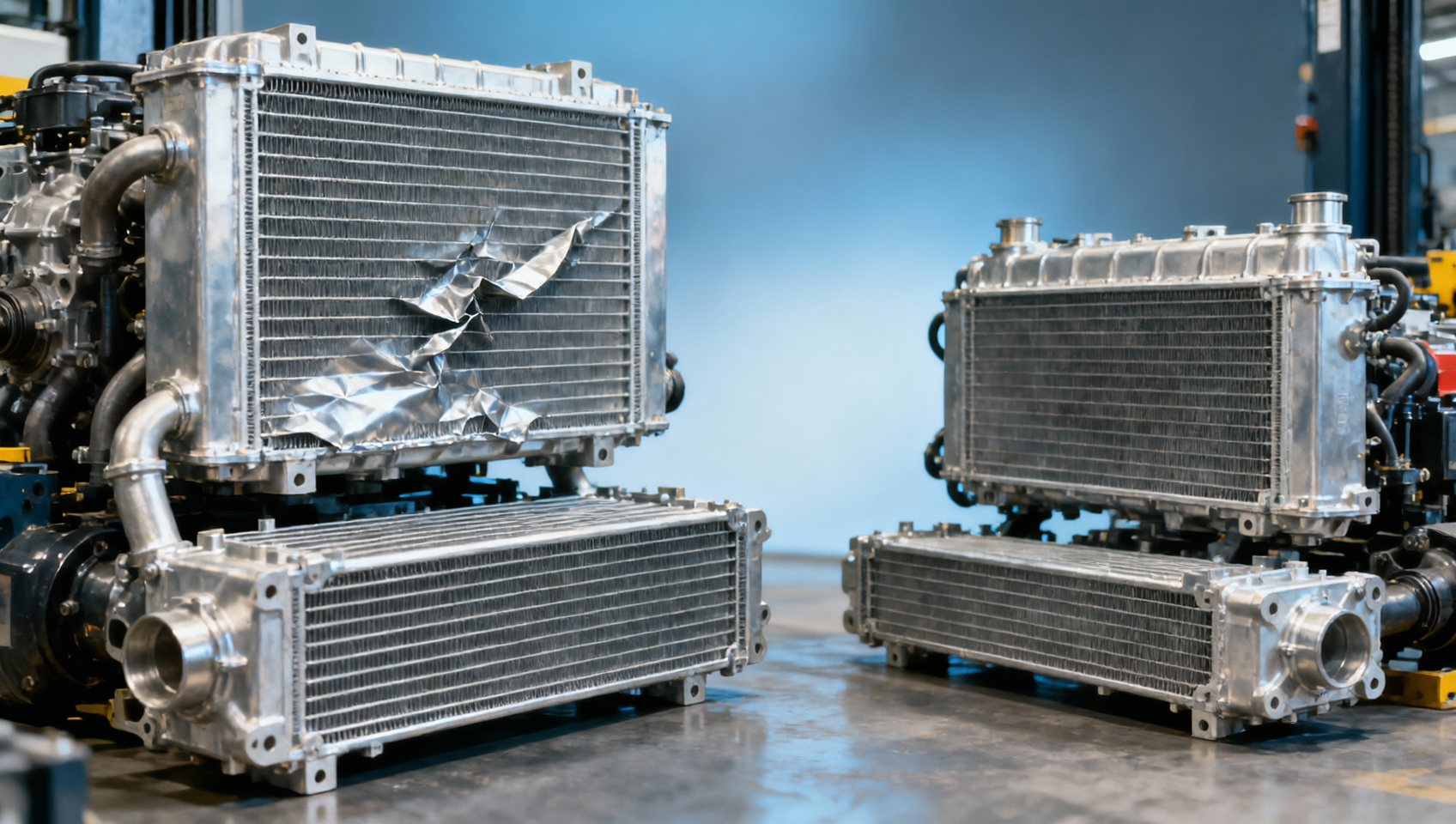
Condenser fin damage can begin long before cooling efficiency visibly declines, making early inspection critical for technical and purchasing teams. In applications involving Heavy duty truck radiator systems, Vehicle radiator assemblies, Excavator radiator units, Agriculturaal radiator solutions, and New Energy Vehicle Radiator modules, hidden fin wear can affect durability, cost, and long-term performance. Understanding these early warning signs helps evaluators and decision-makers reduce risk and choose more reliable components.
For B2B buyers in the auto parts sector, the issue is not only thermal performance on day one, but also how a heat exchanger behaves after 6 months, 12 months, or a full operating season under vibration, dust, stone impact, and repeated thermal cycling. Fin distortion often starts as a small mechanical defect, yet it can gradually reduce airflow uniformity, trap debris, and increase downstream maintenance cost.
This matters directly to technical evaluators, purchasing managers, business reviewers, and enterprise decision-makers who compare suppliers on lifecycle value rather than initial unit price alone. Liaocheng Xinde Auto Parts Co., Ltd., established in 2018 with a registered capital of 5 million RMB and a total investment of 50 million RMB, focuses on the R&D, production, and global sales of radiators, intercoolers, construction machinery radiators, heavy truck cooling parts, and new energy radiator modules. Its rapid development and regional honors reflect a manufacturing direction aligned with reliability, responsive supply, and practical engineering value.
Why Fin Damage Appears Earlier Than Most Teams Expect
Condenser and radiator fins are intentionally thin because they must maximize heat-transfer area while keeping airflow resistance within an acceptable range. In many vehicle and machinery cooling modules, fin thickness is only a small fraction of the tube wall, so the fins become the first structure to show stress under external impact. The problem is that early-stage fin damage rarely causes an immediate temperature alarm.
In real operating environments, damage usually begins through 4 channels: road debris impact, handling deformation during installation, vibration fatigue, and corrosion-assisted weakening. A heavy truck or excavator working 8–12 hours per day in dust-heavy zones will expose the condenser face to repeated contamination and cleaning cycles. If cleaning pressure is too high or directed at the wrong angle, bent fins can increase significantly within a single maintenance interval.
Another reason teams miss the issue is that cooling systems often have short-term performance reserves. A module may continue to perform within acceptable temperature range even after 5%–10% of the fin area has been partially blocked or deformed. That masks underlying deterioration until seasonal temperature peaks, heavy loads, or stop-and-go duty cycles push the system closer to its thermal limit.
For procurement teams, this means a supplier comparison based only on pressure test results or basic fitment dimensions is incomplete. Fin geometry stability, braze consistency, material hardness balance, and packaging protection are also critical. A component can pass incoming inspection yet still underperform in the field if fin resilience and transport protection were not considered during sourcing.
Early mechanical and environmental triggers
- Stone or gravel impact at highway speed can flatten localized fin sections before visible tube damage appears.
- Forklift or carton compression during warehousing may deform the frontal core by 2–5 mm, enough to alter airflow paths.
- High-pressure washing above common maintenance practice can fold fin edges and embed contaminants deeper into the core.
- Repeated thermal expansion and engine vibration over thousands of cycles can weaken fin-to-tube bonding quality.
Why delayed symptoms create purchasing risk
When symptoms are delayed, teams may attribute later overheating, fan overrun, cabin cooling reduction, or energy efficiency loss to unrelated causes. That leads to extra diagnostic labor, multiple replacement attempts, and unnecessary service downtime. In fleet or equipment procurement, even a 2%–4% increase in premature replacement rate can materially affect annual operating budgets.
The table below shows why early fin damage is often underestimated during component assessment.
The key conclusion is that visible temperature stability does not prove structural health. For technical and commercial reviews, the earlier focus should be fin condition, core protection, and supplier process control rather than waiting for obvious cooling decline.
What Technical Evaluators Should Inspect Before Performance Falls
A sound inspection process should combine visual checks, dimensional checks, and application-specific risk review. For heavy duty truck radiator systems and new energy cooling modules, the front face of the condenser or radiator core should be examined at incoming inspection, post-installation, and after the first operating period. In many practical programs, the first follow-up at 30–60 days can reveal handling or vibration issues that factory testing alone cannot capture.
Technical teams should not limit inspection to obvious flattening. They should also review fin pitch consistency, blocked micro-zones, coating discontinuity, corner crush marks, and the transition area between mounting brackets and core edges. Even small asymmetry in these areas can suggest that packaging, bracket stiffness, or assembly tolerance requires improvement.
In sectors such as excavator radiator units and agricultural radiator solutions, contamination pattern matters almost as much as visible damage. A core that traps chaff, mud, and oily dust in repeated cycles will lose effective airflow earlier than a cleaner operating environment. If the fin design is too dense for the dust profile, service frequency may rise from once every 2 weeks to 2–3 times per week during peak season.
For purchasing and business review teams, the inspection standard should also link directly to acceptance criteria. If a supplier cannot define packaging method, allowable core face deformation range, or recommended cleaning limits, long-term service risk becomes harder to control even when the unit price appears competitive.
Six inspection points that should be documented
- Check whether fin rows remain uniform across the entire airflow face, especially the outer 20 mm edge zones.
- Record any crushed or blocked area larger than a small localized spot and compare it with total core face proportion.
- Inspect mounting points for stress transfer that may distort the core during tightening.
- Verify whether packaging spacers and corner guards prevented compression damage in transit.
- Review cleaning instructions for pressure direction, distance, and service interval.
- Assess whether the fin density matches the expected contamination load of the target application.
Recommended review matrix for incoming and field checks
The following table can be adapted by QA teams, sourcing teams, and project engineers as a practical screening tool.
The most useful outcome of this matrix is consistency. It gives technical reviewers and non-technical stakeholders a shared basis for comparing suppliers, estimating service burden, and deciding whether a lower-cost part actually offers acceptable lifecycle value.
How Procurement Teams Should Compare Suppliers Beyond Unit Price
In the parts industry, purchasing decisions often begin with fitment, lead time, and price, but condenser and radiator durability depends on a broader set of variables. When fin damage starts before obvious performance drop, the real cost driver becomes lifecycle stability. A cheaper component that needs earlier cleaning, more careful handling, or more frequent replacement may increase total cost over 12–24 months.
Supplier review should therefore include manufacturing consistency, packaging discipline, application engineering support, and responsiveness to field feedback. For example, a supplier with stable production control can often maintain tighter consistency in core assembly, reducing variation between batches. That is especially important when fleets or equipment owners order repeated volumes and need predictable quality from one shipment to the next.
Liaocheng Xinde Auto Parts Co., Ltd. operates in product lines that include water tank radiators, intercoolers, construction machinery radiators, heavy truck cooling components, and new energy radiator modules. For buyers, this specialization matters because application diversity often improves practical understanding of different duty cycles, from highway freight vehicles to construction machinery and newer energy platforms.
Procurement teams should also examine whether the supplier can support tailored selection for different market segments. A luxury passenger application, for instance, may prioritize quiet efficiency and refined thermal behavior, while a heavy-duty commercial application may prioritize debris resistance, serviceability, and long-duration load stability. These are not interchangeable purchasing criteria.
Four commercial questions that reduce sourcing risk
- Can the supplier define packaging protection methods that minimize core face compression during domestic and export transit?
- Does the supplier provide application guidance for cleaning intervals, mounting practices, and contamination-heavy environments?
- Is warranty policy clearly stated, and are claim conditions linked to realistic field-use scenarios?
- Can the supplier support both standard references and targeted fitment for specific OE or replacement needs?
Example of product-fit integration in decision review
A useful example is Radiator for Hongqi, designed for applications such as luxury engines, new energy systems, H series sedans, and HS luxury SUVs. With OE NO. 1301010HA01, model EQM5, Universal specification reference, and a 6-month warranty, this type of part reflects a different evaluation logic than purely heavy commercial cooling modules. Buyers may focus more on quiet efficiency, peak performance stability, and long-term reliability under refined driving conditions.
The takeaway is that fin durability should always be reviewed in relation to application profile. A component intended for premium passenger vehicles, excavators, or agricultural machinery will face different airflow contamination, vibration, and maintenance conditions. Good procurement practice means matching structure and service expectations to actual use, not only comparing catalog dimensions.
Application-Specific Risks in Heavy Trucks, Construction Equipment, and New Energy Systems
Different operating environments create different fin damage patterns. In heavy duty truck radiator systems, long-distance road debris, insects, winter contaminants, and repeated wash cycles can gradually reshape the outer fin layer. Damage may remain scattered and hard to notice, but after several months it can produce irregular airflow zones that reduce cooling margin during uphill or high-ambient operation.
Excavator radiator units and construction machinery radiators face a more severe combination of vibration and airborne solids. Fine dust, sand, and compacted mud can remain lodged between bent fins, increasing cleaning difficulty. If service crews use aggressive pressure to restore airflow, they may worsen the original deformation. In these cases, maintenance procedure design is as important as initial core quality.
Agricultural radiator solutions encounter seasonal residue such as straw, seed fragments, pollen, and oily dirt. The load is often cyclical: moderate in one month, intense in the next. That makes application matching critical. A fin structure suited to cleaner highway use may perform poorly in crop-harvesting conditions, where contamination layers can develop within 1–3 days during peak activity.
New Energy Vehicle Radiator modules introduce another dimension: thermal management integration. Because battery, electronics, and drive systems may share or coordinate cooling strategies, a small loss in exchanger efficiency can affect system balance earlier than expected. Even where temperature alarms do not appear, fan duty, pump activity, or energy consumption may rise first, indicating hidden degradation.
Comparing risk patterns by application
The table below helps decision-makers align inspection and maintenance priorities with actual operating scenarios.
This comparison shows that there is no single “best” fin structure for every platform. What matters is fit between the exchanger design, contamination profile, maintenance capability, and expected service life. That is why technical and commercial teams should review application data together before final selection.
Practical Selection, Maintenance, and Supplier Collaboration Guidelines
Once early fin damage is recognized as a pre-performance issue, companies can build a more practical control plan. The first step is to set acceptance criteria at receiving stage. The second is to align maintenance instructions with the operating environment. The third is to maintain a supplier feedback loop so recurring damage patterns can be traced to packaging, mounting, cleaning, or application mismatch.
A reliable B2B process usually includes 3 checkpoints: incoming inspection, initial field verification, and periodic service review. For fleet buyers or equipment distributors, these checkpoints reduce the chance that a hidden fin problem will grow into broader warranty claims. Even when unit cost is higher by a small margin, the lower service burden may deliver better annual value.
Maintenance guidance should be specific. Teams should define cleaning interval by environment, such as every 1–2 weeks in moderate dust or every 1–3 days in severe agricultural residue conditions. They should also specify cleaning direction, nozzle distance, and visual recheck steps. General statements like “clean regularly” are not sufficient for field control.
Supplier collaboration is equally important. If a manufacturer can respond quickly to drawings, fitment verification, packaging adjustments, or market-specific product needs, buyers gain a more stable long-term supply relationship. That matters in a competitive parts market where delivery reliability and repeat quality influence downstream customer retention.
Recommended implementation workflow
- Define application profile, including duty cycle, contamination type, vibration level, and expected service interval.
- Evaluate supplier samples for core integrity, fin stability, packaging protection, and installation compatibility.
- Set incoming acceptance standards and document any localized fin deformation before installation.
- Run first-cycle field inspection after 30–60 days or one intensive operating period.
- Feed back recurring issues to the supplier for packaging, structure, or service guideline improvement.
FAQ for evaluators and buyers
The following short answers address common sourcing and engineering questions seen in cooling parts review.
How early should fin inspection start after installation?
For most commercial and industrial applications, an initial review within 30–60 days is practical. In severe dust, road debris, or vibration conditions, the first check can be scheduled sooner, especially if the unit is part of a new supplier trial.
What should procurement prioritize if two suppliers quote similar prices?
Prioritize packaging quality, consistency of core assembly, clarity of application guidance, and responsiveness to technical questions. These factors often determine whether fin damage remains manageable or becomes an avoidable service cost later.
Is visible temperature stability enough to approve long-term performance?
No. A system can stay within operating temperature while airflow efficiency is already declining. Hidden fin damage may first show up as more frequent cleaning, higher fan load, or reduced margin in hot weather rather than immediate overheating.
Condenser fin damage often begins as a small structural issue long before it becomes a clear performance problem. For technical assessors, procurement teams, and decision-makers, the smart approach is to evaluate cooling parts through the full lens of application fit, fin durability, packaging protection, inspection discipline, and supplier support. If you are comparing radiator and cooling component options for heavy trucks, construction machinery, agricultural equipment, or new energy platforms, now is the right time to review your selection criteria, request detailed product guidance, and get a solution matched to your operating conditions. Contact us to discuss product details, sourcing needs, or a tailored cooling parts plan for your market.