



Condenser Design Changes Seen at 2026 Trade Shows
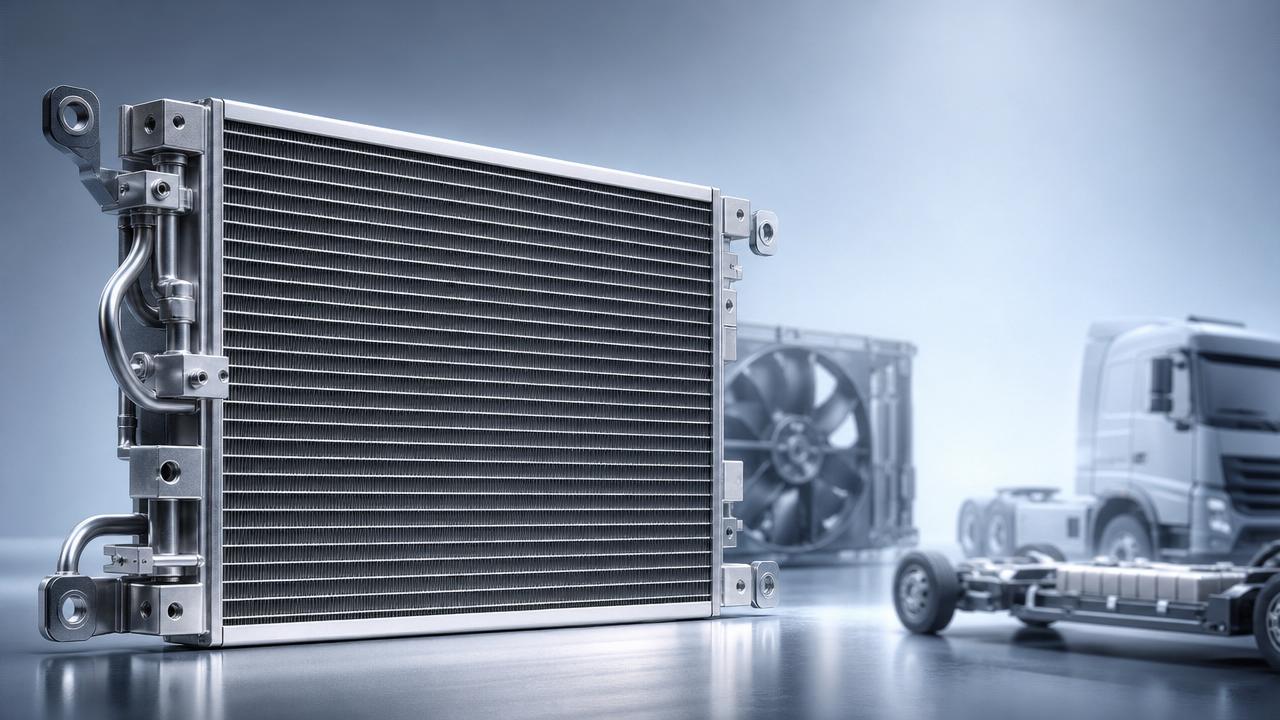
Condenser Design Changes Seen at 2026 Trade Shows
As 2026 trade shows spotlight the next wave of thermal management innovation, Condenser design is drawing closer attention from engineers, buyers, and industry researchers.
Improved heat exchange, lighter structures, and wider vehicle compatibility are changing how parts are evaluated across heavy trucks, construction machinery, and new energy platforms.
For global sourcing, the Condenser is no longer viewed as a simple replacement part. It is becoming a performance-sensitive component within integrated cooling systems.
Basic Role of a Condenser in Vehicle Thermal Systems
A Condenser transfers heat from refrigerant to ambient air, supporting stable air conditioning and broader thermal balance in vehicle operation.
In commercial vehicles, its performance affects cabin comfort, compressor load, fuel use, and the durability of nearby cooling components.
A modern Condenser usually works beside radiators, intercoolers, fans, and control modules. Its design must match airflow and installation space.
This explains why 2026 exhibitions are highlighting system-level thinking, not only isolated heat exchanger specifications.
For heavy trucks and construction machinery, the Condenser must resist vibration, dust, temperature swings, and long working cycles.
For new energy vehicles, packaging density and thermal interaction are more demanding, especially around battery, motor, and cabin cooling circuits.
Industry Signals Observed at 2026 Trade Shows
Trade shows in 2026 reveal several shared directions. Most Condenser updates focus on efficiency, weight control, reliability, and easier integration.
These signals suggest that Condenser selection will increasingly depend on thermal mapping, structural validation, and total lifecycle cost.
Another clear trend is the move toward cleaner brazing, tighter leakage control, and better surface protection for demanding road environments.
Exhibitors are also showing Condenser designs that support lower refrigerant charge, helping systems comply with evolving environmental expectations.
Design Changes Shaping Condenser Performance
Finer flow paths and improved heat transfer
Micro-channel layouts remain central to Condenser innovation. Smaller passages increase contact area and help improve refrigerant condensation speed.
However, smaller channels require better cleanliness control during production. Contamination can reduce flow consistency and shorten service reliability.
This makes manufacturing discipline as important as design theory. Process stability is becoming a sourcing priority for thermal parts.
Lightweight construction with stronger durability
A 2026 Condenser is expected to be lighter without sacrificing pressure resistance, impact tolerance, or corrosion protection.
Aluminum remains widely used because it balances thermal conductivity, manufacturability, and weight reduction for commercial vehicle applications.
The challenge is maintaining fin strength and tube integrity under vibration, debris exposure, and repeated thermal cycling.
Better integration with complete cooling modules
A Condenser must now fit into tighter module spaces, especially where radiators, intercoolers, fans, and electronic controls share airflow.
This increases the value of suppliers that understand complete radiator module engineering, not only individual component production.
For example, radiator compatibility remains essential in vehicle maintenance and platform upgrades.
Products such as RADIATOR FOR VOLVO XD031, with models 22062259, 65479, and 85013015, show how fitment accuracy supports stable cooling performance.
Application Value Across Vehicle and Machinery Segments
The Condenser plays different roles across vehicle categories. Its design must reflect operating load, airflow conditions, and maintenance expectations.
For heavy trucks, Condenser efficiency can reduce compressor strain during long operation under high ambient temperatures.
For construction machinery, durable surface treatment and easy cleaning become major advantages in dusty working areas.
For new energy platforms, the Condenser must support balanced heat rejection while avoiding unnecessary power consumption from fans.
These differences make generic selection risky. Matching design parameters to operating conditions remains essential.
Sourcing Implications for Global Parts Supply
As Condenser designs become more specialized, sourcing decisions increasingly require evidence beyond catalog dimensions and basic material descriptions.
Useful evidence includes pressure testing, leak inspection, salt spray results, vibration testing, and dimensional consistency reports.
A supplier’s experience in radiators, intercoolers, and cooling modules can also improve communication during customization.
Liaocheng Xinde Auto Parts Co., Ltd. was established in 2018 and focuses on thermal management components for demanding vehicle segments.
Its product scope includes water tank radiators, intercoolers, construction machinery radiators, heavy truck parts, and new energy radiator modules.
The company has a registered capital of 5 million RMB and total investment of 50 million RMB.
Its development has been supported by honors including High-tech Enterprise, Civilized and Honest Enterprise, and Trustworthy Unit for Consumers.
Such background matters because Condenser programs often require stable production, responsive engineering, and clear quality control procedures.
Practical Evaluation Points for Condenser Selection
The following points help compare Condenser options with greater accuracy and fewer installation risks.
- Confirm vehicle platform, mounting points, pipe connections, and airflow direction before evaluating price.
- Check core size, fin density, tube layout, and pressure rating against operating conditions.
- Review corrosion protection, especially for coastal, mining, construction, or high-humidity environments.
- Ask for leakage testing standards and packaging methods for long-distance transport.
- Consider total module compatibility with radiators, intercoolers, fans, and brackets.
A Condenser with high theoretical performance may still fail if mounting tolerance or airflow balance is poor.
Likewise, a low-cost unit may create higher service costs through leakage, deformation, or inefficient heat rejection.
For fleet maintenance and parts distribution, repeatable fitment can be as valuable as a single laboratory performance result.
Manufacturing Factors Behind Reliable Condenser Design
Reliable Condenser performance depends on design, materials, tooling, brazing, inspection, and packaging working together.
Tube cleanliness is important because internal contamination can restrict refrigerant flow and affect compressor operation.
Fin alignment also matters. Uneven fins reduce airflow contact and may increase pressure drop across the front module.
Brazed joint quality is another critical point. Small defects can become leakage sources under pressure cycling.
Packaging should protect tube ends, brackets, and delicate fins from compression during international shipping.
These production details explain why proven thermal parts manufacturing remains important as designs become more compact.
Future Direction for Condenser and Radiator Module Solutions
The Condenser will continue moving toward higher efficiency, lower weight, easier maintenance, and tighter integration with intelligent cooling control.
In new energy vehicles, module design will likely focus on balancing cabin comfort with battery and power electronics temperature needs.
In heavy-duty applications, strength and serviceability will remain decisive, especially for vehicles operating across long routes and harsh climates.
For construction machinery, protection against dust blockage, vibration fatigue, and surface corrosion will remain central design priorities.
These developments point to a broader shift from single-part replacement toward engineered cooling system solutions.
Actionable Next Steps for Condenser Planning
Start by defining the vehicle type, working environment, thermal load, refrigerant requirements, and service expectations.
Then compare Condenser options by performance data, structural details, test documentation, and compatibility with surrounding radiator modules.
When possible, evaluate suppliers with experience across radiators, intercoolers, heavy truck components, and new energy cooling assemblies.
This approach reduces sourcing uncertainty and supports better long-term operation in demanding parts applications.
The 2026 trade show trends make one point clear: Condenser design is becoming more precise, more integrated, and more strategically important.
For upcoming projects, review current cooling requirements early and align product selection with verified engineering capability.