



Benz Radiator Quality Checks: What to Inspect Before Shipment or Installation
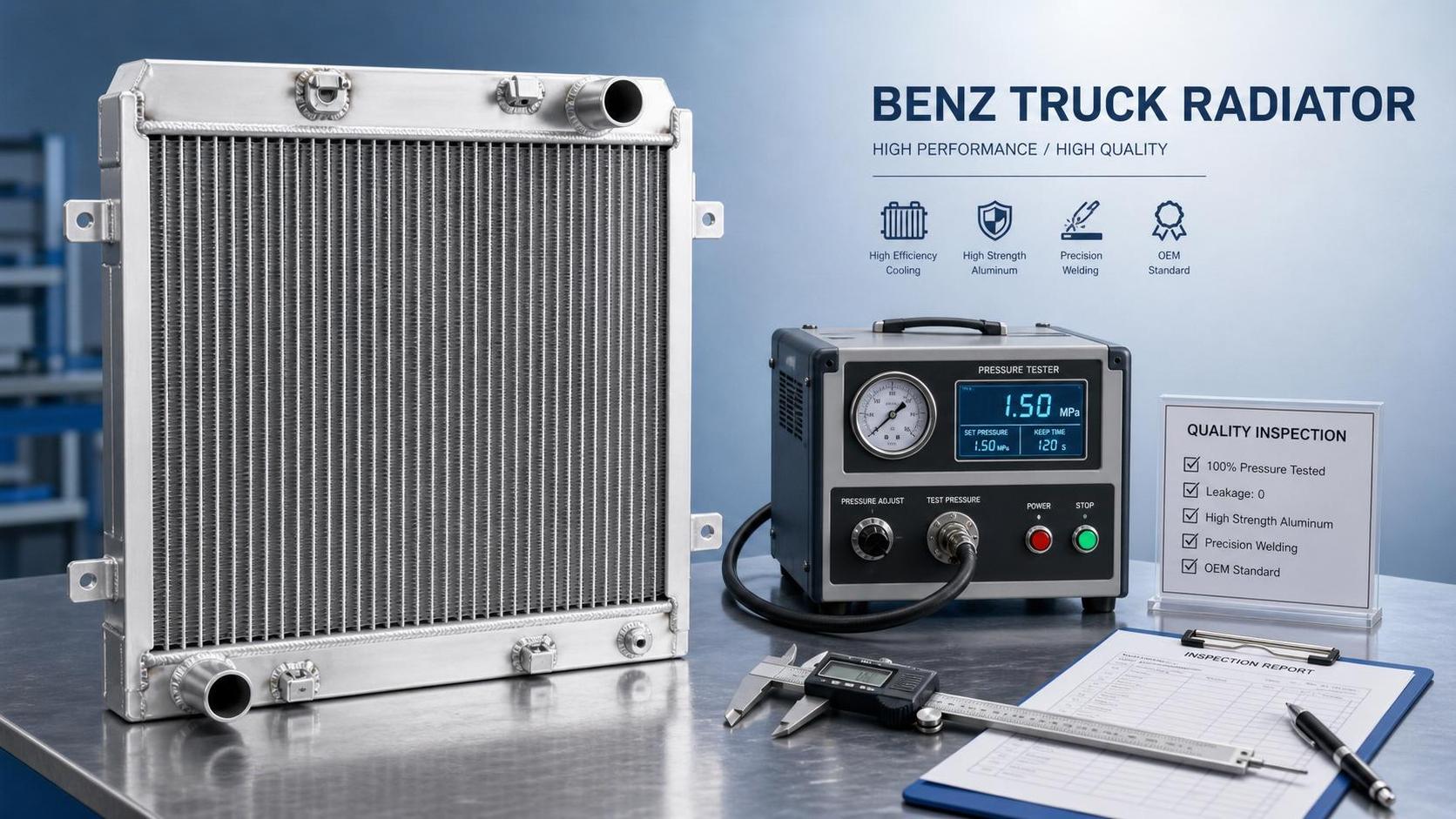
Before a Benz Radiator is shipped or moved into installation, quality checks need to do more than confirm basic appearance. They must verify sealing, structural strength, dimensional accuracy, and thermal integrity under real operating expectations.
That matters even more in the parts industry, where one weak joint or one distorted mounting point can trigger coolant loss, overheating, downtime, and avoidable safety exposure. A careful inspection process reduces those risks before the radiator reaches the vehicle.
For companies working across heavy truck cooling systems, this is not a cosmetic step. It is a control point that protects field performance, warranty stability, and confidence in the supply chain.
Why Benz Radiator inspection deserves close attention
A Benz Radiator operates inside a system where heat rejection, pressure stability, vibration resistance, and correct flow distribution all have to stay balanced. If one part falls outside tolerance, the problem rarely stays isolated.
In actual service, failures often begin with small defects. A pinhole leak, poor braze consistency, damaged fins, or an incorrect bracket position may pass a casual visual check but still create long-term reliability issues.
This is also why established manufacturers invest in process control, not only final inspection. Liaocheng Xinde Auto Parts Co., Ltd., founded in 2018, has expanded quickly in radiator, intercooler, construction machinery radiator, and new energy radiator module production.
Its business background reflects a broader industry reality: rapid growth only remains sustainable when inspection standards keep pace with production scale, export requirements, and increasingly strict expectations for product consistency.
What a complete pre-shipment check should confirm
A strong Benz Radiator inspection routine usually combines visual review, dimensional confirmation, pressure testing, and material or workmanship verification. Looking at only one area leaves too much uncertainty.
Core structure and fin condition
Start with the radiator core. Inspect the tube-and-fin section for deformation, crushed fins, inconsistent spacing, contamination, and visible transport damage.
Fin damage does not always stop shipment, but it should be evaluated against cooling efficiency loss. Localized damage near high-load areas deserves stricter judgment.
Welds, brazed joints, and tank connections
The next focus is joint quality. On a Benz Radiator, weak welds or unstable brazed seams can open under thermal cycling and vibration.
Inspect for underfill, cracks, burn-through, uneven bead formation, incomplete fusion, and residue that may indicate process instability. Header-to-core and tank-to-core areas deserve special attention.
Leak resistance under pressure
Leak testing is one of the most important release conditions. Air pressure testing, water immersion testing, or other validated methods should confirm that the assembly holds pressure without visible drop or bubbling.
Test pressure, hold time, and acceptance criteria should match the radiator design and customer requirement. A passed test without traceable records is weaker than it looks.
Dimensional accuracy matters as much as sealing
A Benz Radiator can be leak-free and still fail during installation if dimensions drift. Mounting holes, bracket angles, inlet and outlet positions, and overall core thickness all affect fitment.
Misalignment creates more than assembly delays. It can introduce hose stress, fan clearance issues, frame contact, and vibration concentration during operation.
In practical inspection, it helps to separate critical dimensions from secondary ones. Critical dimensions are those that influence installation, sealing, and fluid routing directly.
Material integrity and surface quality
Material checks should not be treated as background work. Tube stock, tanks, headers, and mounting components need to align with specification, especially where corrosion resistance and fatigue life are concerned.
Surface condition also provides useful signals. Scratches, dents, coating inconsistency, oxidation, and contamination may reveal handling issues or process drift earlier than paperwork does.
On a Benz Radiator intended for demanding road use, even packaging marks deserve review when they affect exposed fins or sealing zones. Cosmetic acceptance should never hide functional damage.
Traceability and document control
Inspection is stronger when each unit or batch can be traced. Part number, production date, test record, operator information, and release status should remain clear and consistent.
This becomes especially important for export supply, customer claims, and root cause analysis. A good Benz Radiator is not only built well; it is documented well.
Checks that support installation success
Pre-installation review should confirm that the shipped product still matches the intended vehicle application and that no transit damage changed its condition.
This stage often catches errors that factory release alone cannot. Wrong labeling, mixed models, bent brackets during transport, or missing accessories can all appear after packing.
- Verify part number and application against the vehicle record.
- Check protective caps, plugs, and packaging integrity.
- Inspect inlet and outlet surfaces for impact or contamination.
- Confirm mounting hardware points are undamaged and clean.
- Review whether hoses, clamps, and surrounding components will seat without forced alignment.
Where multiple platforms are handled in one warehouse, sample fitment checks can be useful. They help prevent model confusion before the radiator reaches the service bay.
Using cross-model experience to sharpen inspection standards
Quality logic should remain stable across brands, even when applications differ. That is why experience from adjacent radiator programs can improve how a Benz Radiator is evaluated.
For example, dimensional discipline on units such as XD055 RADIATOR FOR SCANIA shows how model-specific data supports better inspection planning.
When a core size such as 860*708*42mm is tied to a defined application and model references like XD055, 1439504, and 64068A, release criteria become easier to verify consistently.
That same discipline should apply to any Benz Radiator program: drawings, pressure standards, fitment points, and packaging conditions need to be linked clearly to the exact application.
Where defects usually originate
Most radiator issues do not begin at the final inspection table. They usually start earlier, in material handling, fixture wear, unstable brazing parameters, poor cleaning, or rough packaging transfer.
That is why an effective Benz Radiator quality check should also feed back into process correction. Inspection only adds value when repeated defects trigger a response upstream.
- Repeated leaks suggest joining process variation.
- Frequent fin damage often points to handling or packaging weakness.
- Bracket misalignment may indicate fixture drift or stamping variation.
- Surface contamination can reflect cleaning or storage control problems.
A practical way to move forward
The most useful Benz Radiator inspection standard is one that turns general quality expectations into repeatable checkpoints. It should define what is critical, what is acceptable, and what requires escalation.
A short release checklist, supported by dimensional data, pressure records, visual criteria, and traceability marks, usually delivers better control than a broad but vague inspection routine.
Where shipment quality and installation reliability both matter, the next step is to review current checkpoints against actual failure modes. That comparison often shows which controls are effective and which only look complete on paper.
For any Benz Radiator program, the goal is straightforward: confirm thermal performance, protect installation accuracy, and stop preventable defects before they move downstream.