



Agricultural radiator choices that reduce peak season risk
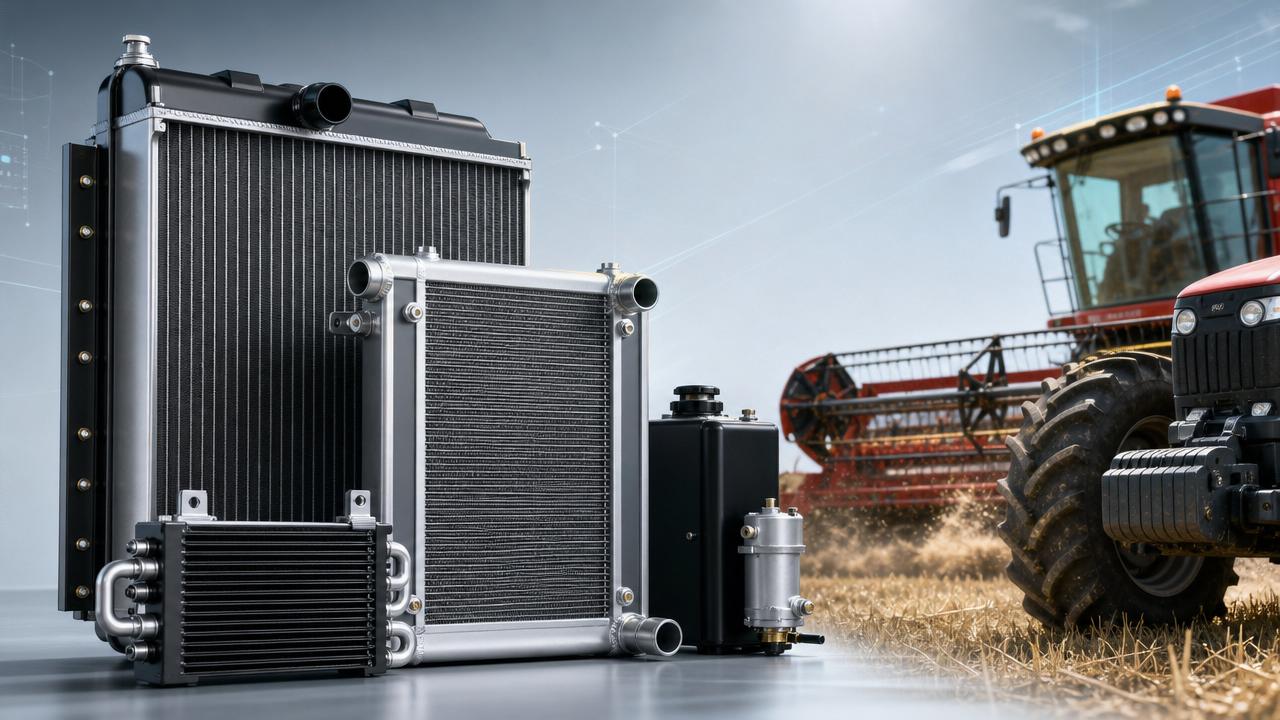
Agricultural radiator choices that reduce peak season risk
Peak season leaves no room for cooling failures, especially when uptime drives every project milestone.
Choosing the right Agriculturaal radiator lowers breakdown risk, protects engine efficiency, and supports stable field output.
In heavy-duty parts decisions, cooling performance is never only technical.
It directly affects maintenance intervals, fuel use, repair timing, and machine availability during the busiest weeks.
A reliable supplier also matters.
Liaocheng Xinde Auto Parts Co., Ltd. focuses on radiators, intercoolers, construction machinery radiators, and new energy radiator modules.
Its manufacturing growth, technical capability, and recognized quality record support global parts demand with practical consistency.
When field conditions change, Agriculturaal radiator requirements change too
Not every machine faces the same heat load, dust level, or work cycle.
That is why Agriculturaal radiator selection should begin with actual operating conditions, not only part dimensions.
Harvesting equipment often runs for long hours with limited shutdown windows.
Irrigation systems may operate in hot weather with continuous engine demand.
Transport tractors can face alternating low-speed pulling and road movement, creating unstable airflow patterns.
A correct match depends on thermal capacity, core strength, anti-clogging design, and service access.
Ignoring one of these factors increases peak season interruption risk.
Scenario 1: Long harvesting shifts demand durable cooling stability
Why harvest periods are hard on cooling systems
During harvest, engines remain under sustained load for many hours each day.
Airflow passages collect chaff, dust, and plant debris quickly.
An Agriculturaal radiator in this setting needs strong heat rejection and good resistance to external blockage.
Core fin density should balance cooling efficiency with cleanability.
If the fins are too tight, contamination can reduce airflow faster than expected.
What to check before ordering
- Tube and fin construction for sustained thermal cycling
- Tank and header strength under vibration
- Ease of surface cleaning between shifts
- Coolant flow compatibility with engine output
- Seal quality to prevent leakage during long operation
This is where proven heavy-duty radiator manufacturing standards reduce seasonal uncertainty.
Scenario 2: Dust-heavy tillage work needs anti-clogging radiator design
Tillage, soil preparation, and dry land operations create fine airborne particles.
These particles stick to wet surfaces and narrow cooling passages.
An Agriculturaal radiator used here should support reliable airflow even as contamination builds.
Wider fin spacing can improve maintenance efficiency in this scenario.
Material choice also matters because dust can combine with vibration and moisture, accelerating wear.
It is useful to review how often cooling packs can be cleaned without disassembly.
A part that cools well in testing may still fail in the field if cleaning takes too long.
Service practicality is part of real cooling performance.
Scenario 3: High-load transport and mixed use call for balanced radiator performance
Some agricultural machines switch between field work and transport duty.
Load, speed, and ambient conditions can change several times in one day.
In this case, an Agriculturaal radiator should offer stable response across variable airflow and engine demand.
Over-specialized radiator designs may perform well in one mode and poorly in another.
A balanced unit should combine thermal reserve, structural reliability, and fit accuracy.
Mounting alignment is especially important for machines exposed to frequent shock and uneven terrain.
Even a strong core can fail early if installation stress is not controlled.
How scenario differences affect radiator selection priorities
This comparison shows why one-size-fits-all cooling decisions often create hidden operating costs.
Practical selection advice for a lower-risk Agriculturaal radiator plan
A lower-risk cooling plan starts with measurable criteria rather than assumptions.
- Match radiator capacity to real engine load, not rated output alone.
- Review dust exposure, crop residue, and cleaning frequency together.
- Confirm tank, core, and bracket durability for vibration-heavy operation.
- Check replacement lead time before peak season begins.
- Use suppliers with proven radiator and heavy equipment cooling experience.
Supply readiness is often overlooked until breakdowns happen.
For fleets with mixed equipment, cross-reference options can simplify spare planning.
For example, some operations also review solutions such as radiator for mack xd93319 when comparing heavy-duty cooling construction and model compatibility paths.
Reference models including 25173861, 1003347, 1102085, and 1003458 can support technical comparison during parts planning.
Common mistakes that increase peak season cooling failures
Mistake 1: Choosing only by size
Physical fit does not guarantee thermal suitability.
The wrong core design can still cause repeated overheating.
Mistake 2: Ignoring contamination patterns
Field residue differs by crop, soil, and weather.
An Agriculturaal radiator should be selected with real contamination sources in mind.
Mistake 3: Underestimating vibration damage
Road shock, uneven ground, and constant equipment movement stress radiator joints.
Weak mounting points can shorten service life even when cooling capacity looks sufficient.
Mistake 4: Waiting too long to secure supply
Peak season demand can tighten lead times across the parts market.
A strong product is less helpful if replacement availability is uncertain.
Next steps for smarter seasonal radiator decisions
The best Agriculturaal radiator choice comes from linking scene-specific risk to part-specific performance.
Start by listing equipment type, duty cycle, contamination level, cleaning method, and expected ambient temperature.
Then compare radiator construction, heat dissipation capacity, vibration resistance, and delivery reliability.
This process reduces unplanned downtime and improves confidence before the busiest operating window arrives.
With experienced cooling system support and dependable manufacturing, seasonal risk becomes easier to control.
That is the practical value behind a better Agriculturaal radiator strategy in modern parts planning.