



What core volume means when choosing an intercooler for a modified engine
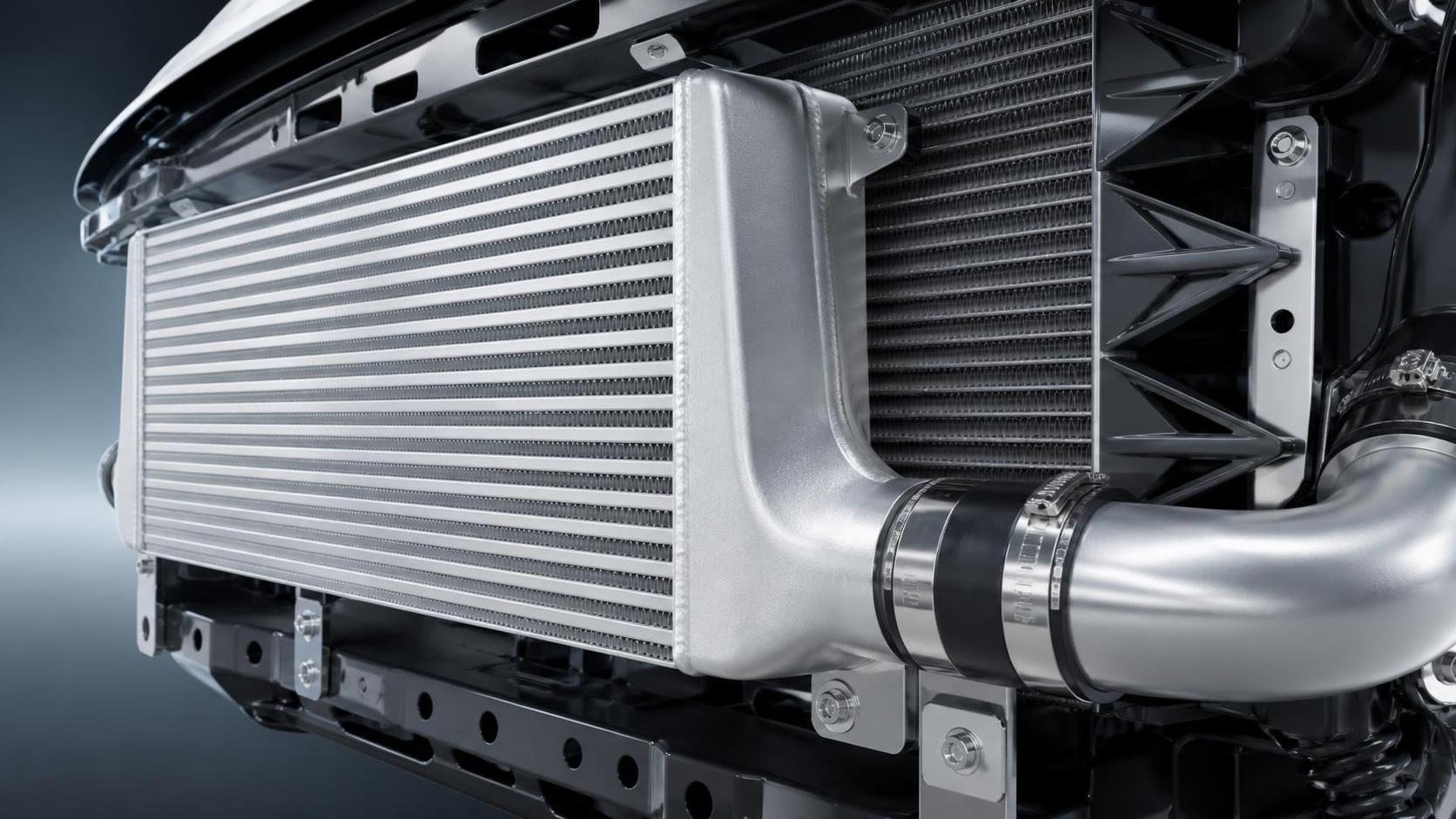
Core volume is one of the first intercooler specifications people notice when planning a modified engine, but it should never be treated as a simple “bigger is better” number. The right intercooler core must remove enough heat from the compressed intake charge without creating excessive pressure drop, poor airflow through the radiator stack, installation conflicts, or slow transient response. A large core can be useful. It can also be the reason a well-planned build runs hotter in traffic or loses boost across the charge-air system.
The practical question is not “What is the largest intercooler that fits?” It is: “What core volume can support this engine’s real airflow, boost target, duty cycle, and available cooling-air path?” That distinction is where many selection decisions go wrong.
What Intercooler Core Volume Actually Tells You
Core volume is the internal and external space occupied by the heat-exchange section of an intercooler. It is usually understood from the core’s height, width, and thickness. A core measuring 600 mm wide, 300 mm high, and 76 mm thick has more external volume than a 600 x 300 x 50 mm core, but that does not automatically mean it will cool better in every installation.
Volume is a starting point because it affects how much heat-transfer surface can be built into the core and how long the compressed air remains in contact with that surface. More internal passage area and fin surface can improve charge-air cooling capacity, especially during sustained high-load operation. Yet the actual result depends heavily on core construction:
- Internal fin density and passage shape affect heat transfer and pressure loss.
- External fin design determines how effectively ambient air can cross the core.
- Tube layout, end-tank design, and air distribution determine whether the full core is used efficiently.
- Core thickness changes cooling potential, but also changes resistance to airflow.
Two intercoolers with similar outside dimensions can therefore behave very differently. One may provide low intake-air temperatures with manageable boost loss; the other may show good results during a short pull but become restrictive under continuous load. Catalog dimensions alone cannot settle the decision.
In simple terms: core volume gives an indication of cooling potential, not a guaranteed performance rating. It must be evaluated with airflow demand, core design, and installation conditions before it becomes a useful selection criterion.
Why a Larger Intercooler Is Not Always the Better Choice
The most common mistake is sizing the intercooler around peak horsepower alone. Peak power matters, but it does not describe how long the engine is loaded, how often it sees high boost, how much frontal airflow is available, or how closely the intercooler sits to the radiator and condenser.
A thick, high-volume core can create three practical problems.
First, it may introduce more pressure drop. As boosted air travels through narrow passages, friction and turbulence reduce pressure. Some pressure drop is expected, but excessive restriction means the turbocharger must work harder to achieve the same manifold pressure. That can raise compressor outlet temperature, increase turbo speed, and reduce the cooling benefit gained from the larger core.
Second, a larger front-mounted intercooler can obstruct airflow to the engine radiator, air-conditioning condenser, and oil cooler. This is especially relevant in vehicles that work under slow-speed load, tow equipment, operate in hot climates, or use tightly packed front-end modules. A cooler charge air temperature is not a complete success if coolant temperature becomes difficult to control.
Third, packaging compromises can undermine the system. Long pipe routes, abrupt silicone couplers, poorly shaped end tanks, or pipes that neck down unnecessarily may add restriction and internal volume outside the core. On a street-driven modified engine, that can affect boost response more than the difference between two reasonably sized cores.
There are situations where a larger core is justified: repeated high-load pulls, endurance use, hill climbing, commercial service, high ambient temperatures, or an engine operating well beyond the airflow range of its original charge-air cooler. But the core should be expanded because the heat load and airflow demand require it, not because a large dimension looks more convincing on a specification sheet.
Start With the Engine’s Airflow and Heat Load
Boost pressure is useful information, but it is not enough to size an intercooler. Two engines at the same boost pressure can move very different mass airflow depending on displacement, engine speed, volumetric efficiency, turbocharger choice, fuel, and calibration. Higher mass airflow means more heat must be rejected from the compressed charge air.
For an early-stage selection, gather the operating information before comparing core sizes:
- Engine displacement and intended power range
- Maximum engine speed under load
- Target boost pressure and expected compressor outlet temperature
- Fuel type and calibration strategy
- Expected ambient temperature
- Maximum duration of high-load operation
- Available frontal area and ducting arrangement
- Existing radiator, condenser, oil cooler, and fan capacity
This list may appear basic, but projects often skip it because the engine modification is still changing. That leads to a costly pattern: the intercooler is selected around a hoped-for final power figure, then the front-end cooling package is forced to accommodate it. A better approach is to define at least two operating cases: the normal duty point and the worst credible sustained-load point. The intercooler should be assessed against both.
For example, a vehicle used for brief acceleration events may tolerate a core that is optimized for low pressure drop and limited frontal area. A vehicle that climbs grades with high boost for several minutes needs stable heat rejection, not merely a low intake temperature at the beginning of a test. The latter case often benefits from more core area, better duct sealing, and closer attention to the radiator airflow behind it.
Frontal Area Often Matters More Than Extra Thickness
When space allows, increasing frontal area is frequently more productive than simply choosing the thickest core available. A taller or wider core exposes more surface to incoming air. It may achieve the required thermal performance with less airflow resistance than a very thick core placed behind a narrow opening.
Thickness still has a role. A deeper core can provide more heat-transfer area and capacity within a constrained width and height. But airflow does not pass through a deeper core for free. The air-side resistance rises, and the rear portion of a very thick core may receive less effective airflow if the ducting, grille opening, fan system, or pressure difference across the stack is inadequate.
That is why “the largest core that fits behind the bumper” is not a robust specification. The usable grille opening, bumper reinforcement, shrouds, air guides, and exit path all matter. A smaller intercooler with sealed ducting can outperform a nominally larger core that receives air around its edges rather than through its fins.
During design reviews, inspect the whole airflow route. Air must enter the intercooler, cross the fin pack, then leave the engine bay or continue through downstream heat exchangers. If there is no controlled exit path, pressure builds ahead of the stack and bypasses the core. This is easy to miss in CAD layouts because a physically fitting part does not prove an aerodynamically effective installation.
Pressure Drop Is the Counterweight to Cooling Capacity
An intercooler must cool the charge air while preserving as much useful boost pressure as possible. The tradeoff is unavoidable: more internal finning and longer flow paths can transfer more heat, but they can also resist airflow. The goal is not zero pressure drop. The goal is a pressure drop appropriate for the thermal improvement achieved.
Ask suppliers for test conditions rather than relying on an unqualified pressure-drop claim. A quoted figure is only meaningful when paired with airflow rate, measured pressure locations, core configuration, and test method. The same applies to cooling efficiency claims. Without inlet temperature, ambient temperature, airflow rate, and operating duration, the number has limited value for engineering comparison.
End tanks deserve equal attention. A large core with poorly designed end tanks can send most air through only part of the core, increasing local velocity and restriction while leaving other passages underused. Smoothly tapered tanks that distribute flow across the full face of the core are often more valuable than a small increase in nominal core volume.
Installation piping should be reviewed in the same way. Avoid sharp bends immediately before the inlet tank, sudden reductions in pipe diameter, unnecessary coupler steps, and long routes added solely to fit a larger core. These details do not look dramatic individually, but their combined pressure loss can materially change the final system result.
Match the Core to the Duty Cycle, Not Just the Dyno Figure
A dyno pull can be useful for verifying a build, yet it may not reproduce road speed, under-bonnet heat, ambient temperature, repeated acceleration, towing load, or long climbs. The intercooler choice should reflect how the engine will actually be used.
For a lightly modified road vehicle with occasional full-throttle use, a moderate-volume, low-restriction core may be the sensible choice. It can improve charge-air temperature control while retaining quick response and leaving airflow available for the radiator.
For a high-output vehicle used in repeated competition sessions, the selection should favor stable performance after heat soak. That usually means examining frontal area, core density, air sealing, and the ability of the entire cooling stack to operate at temperature. The intercooler alone cannot solve a front-end airflow problem.
For heavy-duty, off-road, or construction-related applications, the concern shifts further toward sustained operation at low vehicle speed. Fan performance, shrouding, debris exposure, vibration resistance, and serviceability may matter as much as headline cooling capacity. A core that performs well in a clean, high-speed airflow environment may not be appropriate in a dusty work cycle with limited ram air.
This broader perspective is familiar to manufacturers working across radiators, intercoolers, construction-machinery cooling systems, and new-energy thermal modules. Liaocheng Xinde Auto Parts Co., Ltd., established in 2018, develops and produces these related cooling components for global markets. For a modified-engine project, that system-level experience is more relevant than treating the charge-air cooler as an isolated part.
Do Not Confuse Radiator Dimensions With Intercooler Sizing
Cooling-package dimensions can be a useful packaging reference, but a radiator core and an intercooler core do different jobs. A radiator transfers heat from coolant to air; an intercooler transfers heat from compressed intake air to ambient air. Their flow paths, fin designs, operating temperatures, and pressure-drop requirements are not interchangeable.
For instance, the listed 665 x 634 mm core size of the XD6018 RADIATOR FOR NISSAN may help assess available module space in a Nissan-related cooling layout. It should not be used as evidence that an intercooler with similar dimensions is correctly sized. The radiator’s mounting arrangement, fan coverage, and downstream airflow need to be checked before placing another heat exchanger in front of it.
This is a useful checkpoint when a modified engine is installed in an existing vehicle platform. Measure the real available opening and the distance between heat exchangers. Identify whether the proposed intercooler blocks a meaningful portion of the radiator. Then decide whether a revised duct, a different core aspect ratio, an upgraded fan system, or a separate cooling layout is needed.
A Practical Selection Sequence
It helps to make the decision in a fixed order. Start by setting the engine airflow and boost target. Next, define the highest realistic ambient temperature and the longest expected high-load event. Then map the actual frontal opening, radiator stack, pipe route, and service clearances.
Only after that should you compare intercooler cores. Shortlist designs that provide suitable frontal area and a credible flow rating for the intended engine. Check pressure-drop data at the relevant airflow range, then review end-tank geometry and connection sizes. Finally, confirm that the selected core can be sealed to the available airflow path and installed without forcing poor pipe routing or compromising the radiator.
Before approving production or procurement, validate the setup with logged data. At minimum, compare intake-air temperature before and after the intercooler, manifold pressure versus compressor outlet pressure where practical, coolant temperature, and ambient conditions during representative load. A single cool-weather pull is not enough evidence for a heat-management decision.
Common Selection Errors That Create Expensive Rework
The first error is buying by thickness alone. A 100 mm core is not automatically superior to a 65 mm core, particularly when the grille opening and radiator airflow are limited.
The second is ignoring pressure drop because the engine still reaches target boost. If the turbocharger is working harder to overcome restriction, compressor efficiency and durability can still suffer. Measure or obtain credible test data rather than assuming the boost controller tells the full story.
The third is treating the intercooler as the final modification. Changes to boost, turbocharger selection, fuel delivery, ignition timing, exhaust backpressure, and engine calibration all alter charge-air temperature and airflow. A core selected early in the project should be reviewed again if the engine specification changes materially.
The fourth is overlooking physical durability. Road debris, vibration, thermal cycling, hose retention, mounting stress, and access for repairs are real considerations. An intercooler that is thermally capable but mounted rigidly to a moving structure, or exposed without protection, may not remain reliable in service.
Choosing the Right Intercooler Core
The correct intercooler core volume is the one that meets the engine’s heat-rejection requirement at its real airflow and duty cycle while keeping pressure drop, packaging impact, and cooling-stack resistance within acceptable limits. It is not necessarily the biggest, thickest, or most heavily marketed option.
Use core volume as a screening specification, then make the final decision from the full system: compressor outlet conditions, expected airflow, frontal area, core construction, end-tank distribution, ducting, piping, radiator interaction, and validation data. That approach produces an intercooler installation that remains consistent when the engine is working hard, rather than one that only looks adequate in a parts list.
Frequently Asked Questions
How much larger should an intercooler be after increasing boost?
There is no reliable percentage rule. Higher boost often raises charge-air temperature, but required size also depends on engine airflow, turbo efficiency, ambient temperature, and how long high boost is sustained. Use operating data and supplier flow information instead of selecting by boost pressure alone.
Can an intercooler be too large for a modified street engine?
Yes. An oversized core can add pressure drop, require long piping, interfere with radiator airflow, and create installation compromises that outweigh its extra cooling capacity. A properly sized core is usually the better street solution.
Is a thicker core always more effective?
No. Thickness adds heat-transfer potential, but it also increases air-side and sometimes charge-side resistance. A larger frontal area with good ducting may work better than a very thick core behind a restricted grille opening.
What should be measured after installation?
Record ambient temperature, charge-air temperature before and after the core where possible, manifold pressure, coolant temperature, and results during the longest representative load event. Compare repeated runs, not just one short acceleration test.
Internal Link Anchor Text Suggestions
- Intercooler core design and pressure drop
- How to size a radiator for a modified engine
- Cooling stack airflow and ducting guide
- Signs of intercooler heat soak
- Radiator and intercooler selection for Nissan applications
External Authority Source Suggestions
- Turbocharger manufacturer technical documents covering compressor maps, charge-air temperature, and boost-system design
- Vehicle manufacturer service documentation for cooling-system layout, airflow paths, and original equipment limits
- Automotive engineering publications or academic research on compact heat exchangers and charge-air cooling performance