



Setting maintenance intervals by heavy truck cooling system duty cycle
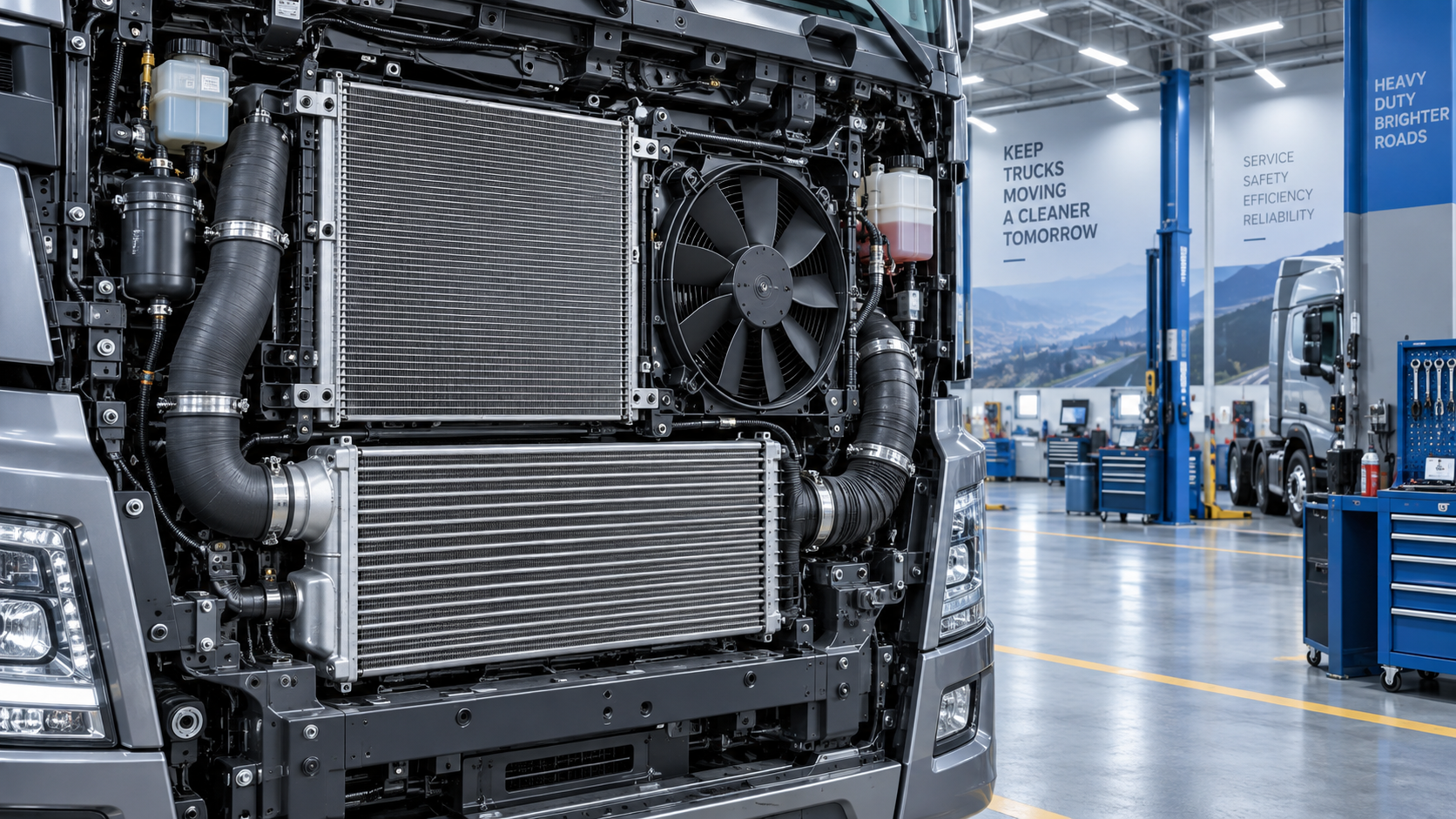
Setting maintenance intervals for a heavy truck cooling system requires more judgment than following a fixed mileage number in a service book. Two trucks with identical engines may travel the same distance while placing very different demands on their radiators, charge-air coolers, hoses, fans, and coolant. One may cruise on open highways with steady airflow; the other may spend its days climbing grades, hauling at maximum weight, idling at loading bays, or working through dusty construction access roads.
For aftermarket maintenance teams, the practical question is not simply, “How many kilometers since the last service?” It is, “How hard has this cooling system been asked to work?” A duty-cycle-based approach turns that question into a repeatable inspection plan. Done well, it can catch blocked heat exchangers, declining airflow, coolant loss, and intercooler damage before they become an overheating event, a roadside recovery, or a costly loss of engine power.
Why mileage alone does not define cooling-system wear
Mileage is still useful, but it is only one part of the maintenance picture. The cooling circuit accumulates stress whenever the engine produces heat, whether the truck moves ten kilometers or sits stationary with the engine running. High torque operation, frequent regeneration events, stop-start urban routes, and extended idling can all raise the thermal burden without adding much distance to the odometer.
The external side of the cooling pack also follows its own wear pattern. A truck used in a clean long-haul lane may keep its radiator and intercooler fins relatively clear for months. A tipper, mixer, logging truck, or construction-support vehicle can collect dust, chaff, mud, insects, oily residue, and road debris in far less time. Once airflow through the stack is restricted, the fan has to work harder and the entire heavy truck cooling system operates with less margin on hot days or steep routes.
That is why a calendar-and-mileage schedule should be treated as the baseline, not the final decision. The maintenance interval needs to move according to operating reality.
Classify the duty cycle before assigning service intervals
A simple three-band system is often enough for a workshop to begin. The goal is not to create excessive paperwork. It is to give technicians and fleet planners a shared language for determining which vehicles deserve closer attention.
A truck can move between categories during the year. For example, a tractor unit may operate in normal line-haul service through winter, then spend a busy summer hauling heavy loads through mountainous routes. Maintenance planning should change with the assignment. Treating every vehicle as permanently “normal duty” is a common reason early warning signs are missed.
Build intervals around triggers, not just dates
The most useful plans combine scheduled checks with condition triggers. A scheduled check ensures that nothing is ignored. Triggers identify vehicles that need attention sooner.
Operational triggers
- Repeated operation near the upper end of the engine temperature range, even without an active warning lamp.
- More frequent or louder-than-usual fan engagement during normal work.
- Increased idling caused by loading queues, traffic, auxiliary equipment, or cold-weather practices.
- Changes in payload, route gradient, ambient temperature, or road surface.
- Work in harvest periods, dust seasons, or locations with airborne fibers and debris.
Workshop triggers
- Coolant level dropping between inspections, dried residue around connections, or a recurring need to top up.
- Visible debris between the radiator, condenser, and intercooler cores.
- Bent fins, damaged core faces, corrosion, or evidence of impact from stones and road debris.
- Oil contamination on the charge-air side, loose clamps, split boots, or boost-related fault codes.
- Uneven heat patterns, restricted coolant flow, or a pressure test that indicates leakage.
When one of these signs appears, the vehicle should not wait for its next mileage milestone. An inspection may reveal a minor cleaning requirement or a clamp issue; either outcome is far better than discovering the problem after an overheated engine has already derated.
The inspection rhythm that works in real service bays
Daily drivers’ checks and formal workshop inspections serve different purposes. Drivers are best placed to report warning messages, unusual fan noise, coolant smell, visible leakage, or a temperature gauge that behaves differently on familiar routes. Maintenance personnel need the time and access to inspect the cooling pack properly.
At each regular service visit, perform a quick external assessment. Look through the grille and, where access allows, inspect both faces of the heat exchanger stack. The front surface can look acceptable while material accumulates between cores. Do not judge airflow condition from one visible face alone.
For severe and extreme duty vehicles, include a more deliberate cooling-system review in the preventive maintenance plan. This may involve removing access panels, checking fan shroud integrity, examining mounts and brackets, assessing hose softness or swelling, and confirming that the pressure cap and expansion tank are in sound condition. The exact interval should follow the vehicle manufacturer’s requirements, adjusted downward when duty conditions justify it.
Seasonal checks are especially valuable. Before hot weather, verify core cleanliness, coolant concentration and specification, fan operation, belt condition where applicable, and the condition of charge-air connections. Before winter, confirm freeze protection and inspect for leaks that may have been hidden by dry summer conditions. A system that is merely adequate in mild weather may have no reserve when ambient temperatures shift.
Cleaning the cooling pack without creating a new problem
Cleaning is one of the most misunderstood tasks in heavy truck cooling system maintenance. A core blocked by dust or organic material needs attention, but aggressive cleaning can bend fins, drive debris deeper into the stack, or damage delicate tubes and joints.
Use the equipment manufacturer’s guidance for pressure, nozzle distance, cleaning agents, and access procedures. In many cases, the cleaning direction should oppose the normal airflow so trapped debris is pushed back out rather than packed further in. If the stack cannot be cleaned effectively from the outside, partial disassembly may be necessary. That decision takes more labor, but it is often preferable to repeated overheating complaints and weak airflow.
Technicians should also distinguish dry contamination from oily contamination. Dry dust and chaff can often be removed with suitable air or low-pressure washing procedures. Oily films bind fine dirt to the fins and may require an approved cleaner. Before applying chemicals, consider surrounding components, coatings, electrical connections, and environmental disposal requirements.
A clean core is not automatically a healthy core. After cleaning, inspect for flattened fin sections, corrosion, loose mounting points, and leaks that may have been hidden under debris. If a core has sustained broad fin damage or repeated contamination-related stress, cleaning alone may no longer restore reliable heat transfer.
Intercooler condition belongs in the interval plan
The intercooler is sometimes treated as a separate boost-system component rather than part of cooling maintenance. In practice, its condition affects engine performance, thermal management, and driver confidence. A restricted external core reduces charge-air cooling. An internal leak, cracked tank, damaged tube, or poor hose connection can reduce boost pressure and lead to reduced power, fault codes, smoke, or higher fuel consumption depending on the engine’s control strategy.
During inspection, check the charge-air cooler for external blockage and impact damage, then examine hoses, clamps, and connections for oil traces, abrasion, looseness, and distortion. A light oil film may require investigation rather than immediate assumptions; the key is to identify whether it is stable residue or evidence of a developing leak path. Pressure testing should follow the appropriate vehicle procedure and should not be improvised beyond component limits.
When replacement is required, correct fitment matters as much as core size. For Mercedes-Benz applications, the XD344 INTERCOOLER FOR MERCEDES-BENZ is identified by OEM reference 9735010301 and a 568 × 790 × 64 mm core size. Matching the specified application, connection layout, mounting arrangement, and dimensions helps the workshop avoid installation delays and airflow conflicts within the cooling pack.
Use operating data to refine the next interval
A practical condition-based program improves over time. After each inspection, record more than “checked OK.” Note the vehicle’s duty band, core contamination level, coolant top-up requirement, visible fin condition, fan-related observations, and any corrective action taken. These short records help a workshop see patterns that individual service tickets can hide.
For example, if several trucks on the same site repeatedly show debris accumulation before their planned inspection, the right response is not simply to clean them more often. The team should review route conditions, grille protection, cleaning access, driver reporting habits, and whether the interval classification is too lenient. Likewise, if highway trucks are consistently clean and thermally stable, their resources can stay focused on the vehicles that face greater risk.
Where vehicle telematics or diagnostic tools are available, use temperature trends and fault history as supporting evidence. A single high-temperature event during an exceptional load may not demand a major change. A gradual upward trend under similar operating conditions is more meaningful. Data should guide technician judgment, not replace it.
Common interval-setting mistakes
Waiting for an overheating warning. Warning lamps are important, but they are late-stage indicators for a maintenance strategy. By the time a warning appears, the system may already be operating with restricted airflow, coolant loss, or reduced charge-air performance.
Cleaning every truck the same way. Over-cleaning low-risk vehicles wastes time, while a fixed interval may leave high-contamination trucks neglected. Match the cleaning and inspection frequency to actual exposure.
Focusing only on coolant. Coolant quality is essential, but it does not compensate for blocked fins, weak airflow, a failing fan control system, damaged shrouding, or intercooler leakage.
Replacing a core without checking the cause. A new radiator or intercooler can fail early if the original issue was vibration, debris ingress, incorrect cleaning practices, a faulty mount, or a pressure-control problem. The replacement process should include a root-cause review.
A maintenance interval should protect uptime, not merely satisfy a checklist
The strongest heavy truck cooling system maintenance plan is flexible enough to reflect real work yet simple enough for technicians to apply consistently. Start with the manufacturer’s required service schedule. Classify each vehicle by duty cycle, add early-inspection triggers, and record what is found. Then adjust the interval when heat, load, idling, contamination, or component condition says the vehicle needs more attention.
For aftermarket teams, this approach creates a calmer service routine. Instead of reacting to overheating complaints at the most inconvenient moment, they can identify cooling-pack restrictions, coolant loss, and charge-air issues while the truck is still available for planned work. That is the real value of duty-cycle maintenance: not a shorter interval for its own sake, but a schedule that reflects how the truck earns its living.