



How altitude affects heavy truck cooling system heat rejection
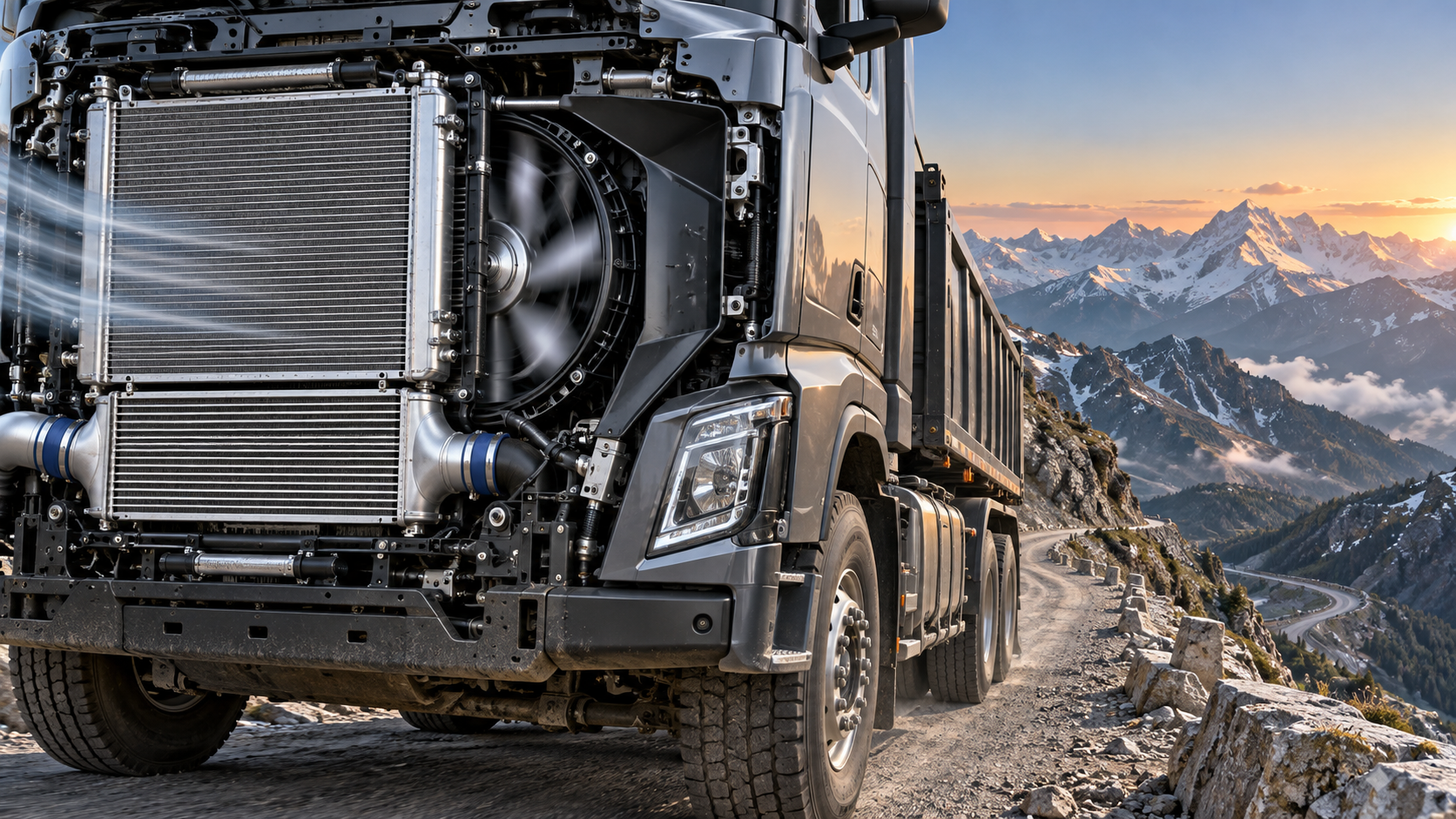
Altitude changes the thermal balance of a heavy truck cooling system because the radiator, fan, intercooler, and under-hood airflow path all depend on air mass, not simply air volume. At higher elevation, lower atmospheric pressure reduces air density. A fan may still move a substantial volume of air, but each cubic metre contains less mass to absorb and carry away heat. The result can be reduced radiator heat rejection, higher charge-air temperatures, and a smaller operating margin during sustained high-load work.
This effect is most visible when altitude is combined with steep grades, high ambient temperature, long low-speed pulls, heavy payloads, mining duty, or restricted airflow caused by dust and debris. A truck that remains stable on a sea-level validation route can approach its thermal limits at elevation even when its coolant, fan, and radiator are functioning normally. The correct question is therefore not whether altitude affects cooling, but whether the complete system has enough margin for the vehicle's actual altitude, load cycle, speed, and ambient conditions.
Why lower air density reduces heat rejection
A radiator transfers heat from hot coolant to the air passing through its core. The available heat transfer depends on several linked factors: coolant temperature, air temperature, core surface area, fin design, airflow distribution, and the mass of air crossing the core. At altitude, the air-side part of this process changes.
For a given fan speed and duct arrangement, reduced-density air has less capacity to absorb heat per unit volume. The convective heat-transfer coefficient on the air side can also decline because the flow properties around the fins change. In practical terms, the radiator sees less effective cooling air, particularly at low road speed when the engine-driven or electric fan must create most of the airflow.
The pressure difference between the hot coolant and the outside air is also affected. Coolant boiling point is governed by pressure, so a cooling system must maintain adequate cap pressure, expansion volume, deaeration performance, and pressure integrity. A sound pressurized circuit provides useful protection, but it does not restore the lost air-side heat rejection. Treating the pressure cap as the solution to an altitude problem is a common evaluation error.
Altitude does not automatically cause overheating. A lightly loaded truck descending a grade in cool weather may have more than enough capacity. The risk appears when heat generation rises while air-side capacity falls. That combination is what should drive design assessment.
Altitude affects more than the engine radiator
The engine radiator is usually the first component considered, but it is rarely the only component competing for airflow. Heavy-duty cooling packs often contain a charge-air cooler, condenser, hydraulic oil cooler, transmission cooler, battery or power-electronics heat exchanger, and other modules. Their order, spacing, and cleanliness determine the temperature and pressure conditions seen by downstream cores.
A charge-air cooler deserves particular attention. Turbocharged engines may operate under high boost during long climbs. If the intercooler rejects less heat at altitude, charge-air temperature rises. The engine control system may then reduce fuel delivery or alter operating strategy to protect the engine and emissions system. Even before a coolant-temperature warning appears, reduced charge-air cooling can affect available torque and gradeability.
Fan performance also needs to be assessed as part of the whole air path. Fan curves are commonly expressed in airflow and pressure terms, but the installed result depends on shroud geometry, core restriction, grille opening, recirculation paths, and the density of the air being moved. A fan that appears adequate in a laboratory-style calculation may deliver insufficient mass flow once it operates against a dense cooling stack at high elevation.
At road speed, ram air can reduce the fan's share of the work. During a slow haul up a steep grade, in contrast, vehicle speed may be too low to support the cooling pack. This is why low-speed, high-load operation is often the governing condition for severe-duty thermal design rather than highway cruise.
Use the operating point, not altitude alone
There is no single “high-altitude radiator size” that applies to every truck. An effective assessment starts with the duty point that creates the greatest heat load and the least useful airflow. Elevation is one input to that duty point, alongside ambient temperature, vehicle speed, gross combination mass, road grade, engine output, auxiliary loads, and contamination exposure.
The assessment should distinguish continuous operation from short transient demand. A truck may tolerate a brief temperature rise after a grade change because the coolant and metal mass absorb heat temporarily. That does not demonstrate adequate steady-state capacity. The relevant question is whether temperatures stabilize below component and control-system limits after the vehicle has remained at the demanding operating point long enough for the system to reach equilibrium.
Ambient temperature must be tied to the intended route rather than treated as a nominal test value. The temperature difference between coolant and incoming air is the driving force for radiator heat transfer. When ambient air is hotter, that difference narrows. When the air is also less dense, the two effects compound. High-altitude cooling evaluation should therefore use a realistic hot-day condition for the operating location, not a mild-temperature altitude correction in isolation.
What should be specified for a thermal assessment
Technical review is more reliable when the vehicle integrator, engine supplier, and cooling-module supplier work from the same boundary conditions. A vague requirement such as “suitable for mountain operation” cannot establish a defensible cooling design. The request should define the conditions that create heat and restrict heat rejection.
- Maximum operating elevation and the duration spent near that elevation.
- Expected ambient temperature range during the heaviest duty cycle.
- Gross mass, road grade, target speed, and whether operation is continuous or intermittent.
- Engine heat-rejection data at the applicable operating point, including charge-air cooling demand where relevant.
- Auxiliary heat loads from air conditioning, hydraulic systems, transmission cooling, or electrified components.
- Available grille area, cooling-stack arrangement, fan type, fan drive, shroud geometry, and permitted package depth.
- Dust, chaff, mud, or insect exposure that can progressively block the air side of the cores.
- Permitted coolant temperature, charge-air temperature, fan noise, power consumption, and pressure-drop limits.
These inputs make it possible to assess radiator performance at the installed condition rather than comparing only frontal area or core thickness. A thicker core is not automatically better. Added depth can increase fin surface, but it may also raise air-side pressure drop. If the fan and vehicle airflow cannot overcome that restriction, the rear part of the core receives weaker airflow and the anticipated gain may not appear in service.
Radiator and cooling-pack choices that matter at elevation
Core selection should balance heat-transfer area with airflow resistance and cleanability. Fin density, louvre geometry, tube configuration, header design, and coolant-side flow distribution all influence the result. In dusty work, an extremely dense fin pattern may offer good clean-core performance but lose capacity rapidly when debris bridges the fins. A design with manageable cleaning access and an appropriate fin geometry can provide more stable field performance than one optimized only for initial laboratory heat rejection.
Air management often provides as much value as changing the radiator itself. The fan shroud should control the fan's suction across the active core face rather than pulling air from gaps around the module. Seals between the grille, stack, shroud, and body structure limit hot-air recirculation. At low vehicle speed, a recirculation path can cause the cooling pack to ingest air that has already been heated by the engine bay, reducing the effective temperature difference across every core.
Variable-speed fans, controlled fan clutches, and appropriately calibrated fan engagement can improve response to changing conditions. They are not substitutes for an undersized heat exchanger, however. A fan can only increase airflow within its available pressure and power range. Higher fan speed also consumes engine or electrical power and can create unacceptable noise. The design objective is a balanced cooling pack with adequate reserve at the critical duty point, not maximum fan speed at all times.
Coolant-side design should receive equal attention. Poor distribution through the radiator, localized tube blockage, trapped air, weak deaeration, incorrect coolant concentration, or a restricted thermostat can reduce the capacity of a core that appears sufficient on paper. At altitude, where air-side reserve is already reduced, these smaller deficiencies become more visible. Pressure testing and flow-path verification are useful because a thermal complaint may originate in the circuit rather than in the radiator's external surface.
Common evaluation mistakes
Comparing only nominal radiator dimensions. Core width, height, and thickness do not describe fin efficiency, tube layout, pressure drop, material thickness, internal flow distribution, or the installed airflow path. Dimensional equivalence is not thermal equivalence.
Using a sea-level fan airflow figure without installed-system context. Fan catalog data must be matched to the resistance of the complete cooling stack and ducting. The airflow that matters is the mass flow through the useful core area under the vehicle's actual operating conditions.
Testing with a clean cooling pack only. For trucks operating around mines, quarries, construction sites, or agricultural dust, reserve capacity must account for reasonable fouling between service events. The issue is not simply whether the radiator can be cleaned, but whether it remains serviceable under the intended cleaning method and access constraints.
Focusing on coolant temperature alone. Charge-air temperature, fan command, condenser load, transmission temperature, engine derate events, and local under-hood temperatures can reveal a shrinking thermal margin before coolant temperature becomes the obvious symptom.
Assuming altitude is the sole cause. A high-elevation complaint can expose an existing weakness: a damaged shroud seal, externally blocked intercooler, worn fan clutch, incorrect fan control calibration, leaking pressure cap, or poor coolant flow. Altitude may be the condition that reveals the fault, not the fault itself.
A practical validation sequence
Start by defining the highest-risk route condition: elevation, ambient temperature, grade, gross mass, speed, and engine operating mode. Then establish the expected heat loads for the engine and all auxiliary circuits. Model or test the cooling pack as an installed assembly, including upstream heat exchangers and airflow restrictions. Evaluate fan operating points against the complete system resistance rather than a free-air rating.
Validation should capture stabilized temperatures and control behavior during the severe duty point. Monitor coolant inlet and outlet temperatures, charge-air temperatures where applicable, fan speed or command state, ambient temperature, engine load, vehicle speed, and any derate response. A test sequence that includes both sustained low-speed climbing and higher-speed operation helps separate fan-limited issues from ram-air-limited issues.
After the clean-system assessment, review likely degradation mechanisms. This includes core fouling, partial grille obstruction, seal aging, coolant contamination, and the maintenance access needed to restore airflow. A cooling system with a narrow clean-condition margin is unlikely to remain robust through normal service exposure.
How to interpret a proposed radiator solution
When reviewing a radiator or cooling module, ask for application-specific thermal reasoning rather than a general statement that it is designed for demanding conditions. The relevant evidence is the relationship between the proposed core, coolant circuit, airflow path, fan capability, and defined operating point. For an aluminum brazed radiator, material and manufacturing method alone do not establish high-altitude suitability; the installed thermal package and validation conditions do.
A component listing such as Radiator for Lynk can be useful for confirming application, construction type, and packaging information in its intended automotive cooling-system context. It should not be used as a proxy for a heavy-truck high-altitude selection. Vehicle class, engine heat load, core-pack layout, fan system, and duty cycle must match before any radiator specification can be transferred between applications.
For heavy-duty projects, suppliers with radiator, intercooler, construction-machinery radiator, and new-energy thermal-module capability can support a broader cooling-pack discussion, but the procurement decision still needs to be tied to the defined duty condition. The most useful supplier input is not a generic capacity claim. It is a technically traceable proposal that identifies the intended operating envelope, airflow assumptions, cooling-stack configuration, and the margin required after normal in-service degradation.
Altitude reduces the margin available to reject heat; it does not change the need for disciplined system matching. A robust design accounts for reduced air density, realistic ambient temperature, fan-limited low-speed duty, charge-air cooling demand, and contamination over time. When those conditions are defined before radiator selection, the heavy truck cooling system can be assessed as a functioning thermal package rather than a collection of individual parts.