



Radiator Core Design Updates Improving Heat Transfer
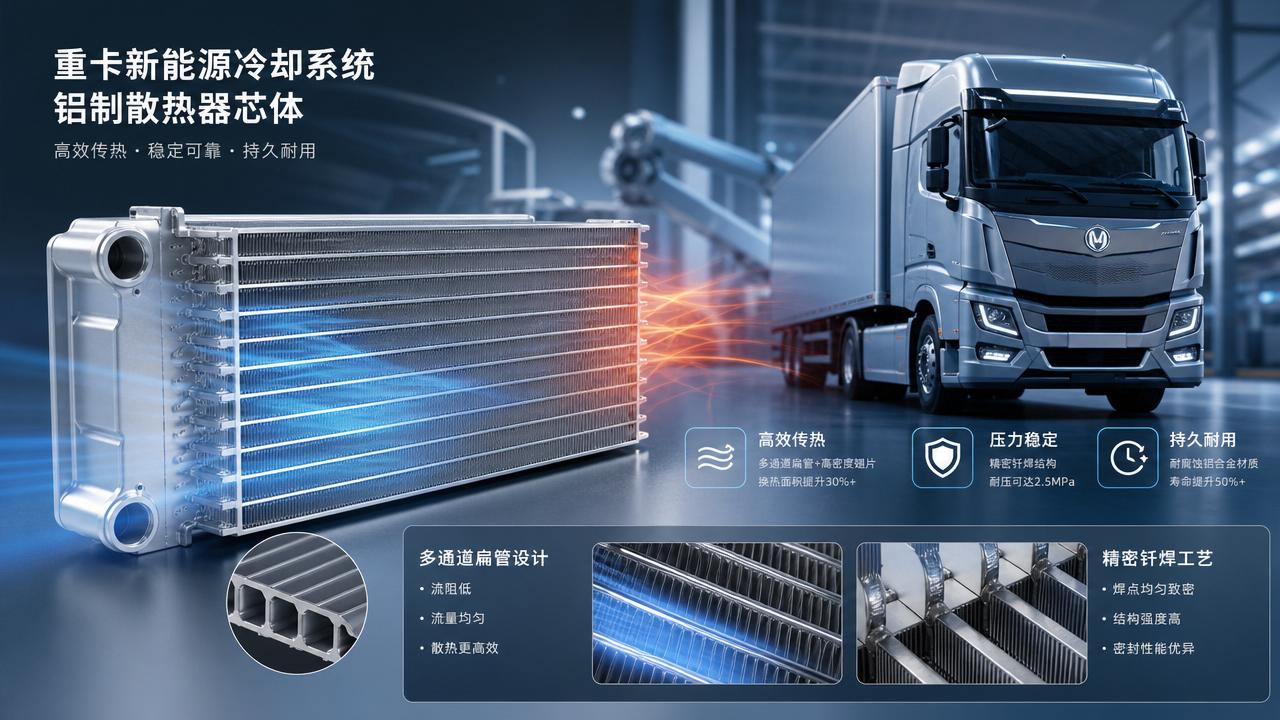
For technical evaluators, radiator core upgrades are no longer just structural changes—they directly affect heat transfer efficiency, pressure stability, and long-term durability. This article explores how modern radiator core design improvements enhance thermal performance in demanding heavy-duty and new energy applications, helping professionals assess material selection, airflow behavior, and manufacturing precision with greater confidence.
Why radiator core design matters more in heavy-duty and new energy systems
In the parts industry, a radiator core is not an isolated component. It influences engine temperature control, battery cooling stability, system packaging, maintenance intervals, and vehicle uptime. For technical evaluators, that means core design must be reviewed as a performance-critical subsystem rather than a simple heat exchanger assembly.
This is especially true in heavy trucks, construction machinery, and new energy radiator modules, where thermal loads fluctuate sharply and operating conditions are severe. Dust, vibration, high ambient temperature, stop-and-go duty cycles, and pressure cycling all expose weaknesses in core geometry, brazing consistency, and material quality.
Liaocheng Xinde Auto Parts Co., Ltd., established in 2018 with a registered capital of 5 million RMB and total investment of 50 million RMB, focuses on the research, production, and global sales of water tank radiators, intercoolers, construction machinery radiators, and related components for heavy trucks and new energy applications. For evaluators, that specialization matters because supplier experience in comparable thermal systems often reduces technical risk during selection.
- A well-designed radiator core improves heat rejection without forcing excessive fan power or coolant pressure loss.
- A poorly matched core may pass basic dimensional checks yet fail in field durability, fouling resistance, or temperature stability.
- Modern evaluations therefore need to combine thermal performance, manufacturability, serviceability, and life-cycle cost.
What has changed in recent radiator core development
Recent radiator core updates are driven by tighter engine compartments, higher heat density, emission-related operating temperatures, and electric platform cooling needs. The market now favors lighter aluminum structures, more precise fin patterns, improved tube layouts, and brazing processes that support consistency across large production batches.
Technical evaluators should therefore ask not only whether a core can remove heat, but how it performs under realistic duty cycles, contaminated airflow, vibration, and repeated thermal expansion.
Which radiator core updates improve heat transfer most directly?
Not every design change contributes equally. Some updates mainly improve packaging or weight, while others create measurable gains in thermal efficiency. The radiator core improvements below usually have the strongest effect on heat transfer behavior when properly integrated into the full cooling system.
High-efficiency fin geometry
Fin density, fin height, louver angle, and fin pitch strongly affect air-side heat transfer. A more advanced fin structure can increase surface turbulence and expand effective contact area, but if over-optimized, it may also raise airflow resistance and trap debris more easily.
Tube shape and coolant path optimization
Flat multi-channel tubes usually offer better area utilization than older, less efficient geometries. They improve heat exchange surface area while supporting compact packaging. Internal coolant distribution also matters. Uneven flow between tubes creates hot zones that reduce the effective contribution of the radiator core.
Material and wall-thickness balancing
Aluminum remains a preferred material because of its favorable thermal conductivity-to-weight ratio and broad compatibility with modern brazed core production. Yet thinner walls are not always better. Evaluators should check whether weight reduction compromises burst resistance, fatigue life, or corrosion margin.
Brazing quality and joint consistency
Heat transfer depends on metal continuity and contact quality throughout the core. Weak brazed joints create local thermal bottlenecks and raise leak risk under pressure cycling. In large-volume manufacturing, process stability is often as important as design intent.
The following table helps technical evaluators connect radiator core design updates with practical engineering impact during sourcing and validation.
The key takeaway is simple: the best radiator core is not the one with the most aggressive fin count or the thinnest walls. It is the one that maintains stable thermal performance under the exact airflow, coolant chemistry, vibration, and maintenance conditions of the target vehicle.
How should technical evaluators compare radiator core options?
Evaluation often becomes difficult because suppliers may present similar dimensions while hiding meaningful differences in internal structure, material grade, and process control. A useful comparison framework separates visible specifications from performance-critical details.
Core comparison points that affect procurement decisions
- Heat rejection target under rated load, partial load, and high ambient conditions.
- Coolant-side pressure drop and its effect on pump demand.
- Air-side resistance and its relationship with fan energy and noise.
- Brazed joint quality, leak resistance, and vibration durability.
- Corrosion tolerance under expected coolant formulations and service intervals.
- Production repeatability, sampling support, and corrective response speed.
This comparison table is useful when reviewing radiator core proposals for heavy truck, bus, construction machinery, or new energy cooling projects.
For evaluators, this side-by-side method reduces the risk of choosing on unit price alone. In many fleets, thermal instability costs far more than a moderate difference in purchase price because downtime, engine stress, and service interruptions accumulate quickly.
What should be checked in application-specific radiator core assessment?
The same radiator core strategy does not fit every platform. Technical evaluation should start from operating conditions, not from catalog dimensions. Heavy trucks, public transportation vehicles, and construction equipment each create different thermal and contamination profiles.
Heavy trucks and long-haul duty
These systems often face sustained thermal load, climbing conditions, and long service intervals. Core selection should prioritize durable brazed joints, corrosion margin, and stable heat transfer even when airflow is partially obstructed by dirt or insects.
Construction machinery
Dust and vibration usually dominate. A high-performance radiator core that clogs quickly or suffers fin damage easily may fail in practice. Evaluators should review cleanability, fin robustness, and field maintenance convenience together with nominal heat rejection.
New energy platforms and buses
Electric buses and hybrid vehicles often require controlled cooling for batteries, electronics, and auxiliary systems in addition to conventional thermal management tasks. Packaging becomes tighter, and stable temperature windows become more important than peak cooling alone.
In public transportation scenarios, evaluators may look at Radiator for Ankai as an example of how premium-grade aluminum and advanced brazing technology can support thermal management for both traditional diesel and new energy electric buses. The practical value is not only heat rejection, but also reduced downtime and better protection of engine or system life under repetitive route cycles.
How to judge material, process, and supplier capability together
A radiator core can look competitive on paper and still create problems after SOP if supplier controls are weak. Technical evaluators should combine design review with manufacturing capability review. This is where supplier specialization becomes important.
Material-related checks
- Confirm aluminum grade suitability for brazing, corrosion environment, and structural demands.
- Review compatibility with coolant chemistry and expected maintenance intervals.
- Check whether wall reduction is supported by mechanical validation rather than only by cost pressure.
Process-related checks
- Review brazing consistency because uneven joints can affect both heat transfer and leak resistance.
- Assess dimensional control for core thickness, fin alignment, header fit, and assembly repeatability.
- Ask how the supplier handles sampling, nonconformance feedback, and production change control.
Liaocheng Xinde Auto Parts Co., Ltd. has developed around radiators, intercoolers, and construction machinery cooling components for global markets, with rapid growth and recognition such as High-tech Enterprise, Civilized and Honest Enterprise, and Trustworthy Unit for Consumers. For a technical evaluator, these points are not a substitute for engineering review, but they do indicate that the company has been operating within a manufacturing framework focused on thermal component development rather than unrelated categories.
Procurement guide: what should technical evaluators request before approval?
When evaluating a radiator core supplier, asking for the right information early helps avoid repeated sample loops and delayed sourcing decisions. The goal is to move from generic claims to verifiable engineering alignment.
- Define the thermal duty clearly, including ambient temperature, coolant flow, fan characteristics, and packaging limits.
- Request core structure details, including tube form, fin type, layer arrangement, and targeted pressure behavior.
- Confirm expected durability conditions such as vibration, working pressure, and contamination exposure.
- Review sample lead time, batch repeatability approach, and whether customization is available for mounting or thermal targets.
- Discuss documentation needed for project approval, such as material information, inspection items, and applicable industry standards.
The table below summarizes practical selection criteria for radiator core procurement in parts projects where delivery pressure and technical validation must be balanced.
This approach is often more effective than comparing catalog sheets alone. It aligns thermal demands, quality expectations, and delivery planning before procurement approval is finalized.
Common mistakes when evaluating a radiator core
Assuming larger size automatically means better cooling
A larger radiator core may increase frontal area, but if airflow distribution is poor or fin resistance is too high, effective heat transfer may not improve as expected. System integration always matters.
Ignoring service environment contamination
A core that performs well in clean bench conditions may lose efficiency quickly in dusty construction or urban bus service. Evaluators should consider clogging tendency and cleaning practicality from the beginning.
Over-focusing on initial purchase price
Thermal failures can increase fuel consumption, reduce component life, and create unplanned maintenance. In many applications, the lowest-priced radiator core carries the highest total operating cost.
FAQ: radiator core questions technical evaluators often ask
How do I know whether a radiator core upgrade is really necessary?
Look for repeated high-temperature events, rising fan demand, unstable pressure behavior, or packaging constraints that leave no room for larger assemblies. If system targets have changed, the original core may no longer match the thermal load.
Which radiator core feature is most important for buses and public transportation?
Stable thermal control under repetitive stop-and-go operation is usually critical. In that context, material quality, brazing consistency, airflow compatibility, and maintenance-friendly design often matter more than one isolated peak-performance figure.
What should be reviewed before approving samples?
Review thermal targets, pressure drop, dimensional fit, material route, durability assumptions, and supplier response to process variation. If possible, compare sample data against expected real operating conditions instead of ideal laboratory assumptions alone.
Is premium aluminum always worth the extra cost?
Not in every case, but for demanding duty cycles it often supports a better balance of conductivity, corrosion resistance, and weight. The decision should be based on operating profile, service interval targets, and total life-cycle economics.
Why choose us for radiator core evaluation and supply support
For technical evaluators, the most useful supplier is one that can discuss radiator core structure, application fit, and manufacturing practicality in the same conversation. Liaocheng Xinde Auto Parts Co., Ltd. focuses on radiator and intercooler manufacturing for heavy trucks, construction machinery, and new energy thermal systems, giving buyers access to application-oriented support rather than only basic catalog quotations.
If your team is assessing a new project or replacing an existing cooling assembly, you can consult on parameters such as core structure selection, thermal application matching, material route, delivery timing, customization feasibility, and sample planning. If public transportation is part of your project scope, Radiator for Ankai can also serve as a reference direction for bus-oriented thermal management using premium-grade aluminum and advanced brazing technology.
Contact us to discuss parameter confirmation, product selection, delivery cycle expectations, custom solution development, certification-related questions, sample support, and quotation communication. A clear technical exchange at the start usually shortens validation time and improves sourcing confidence.