



Integrated thermal modules reshape New Energy Vehicle Radiator demand
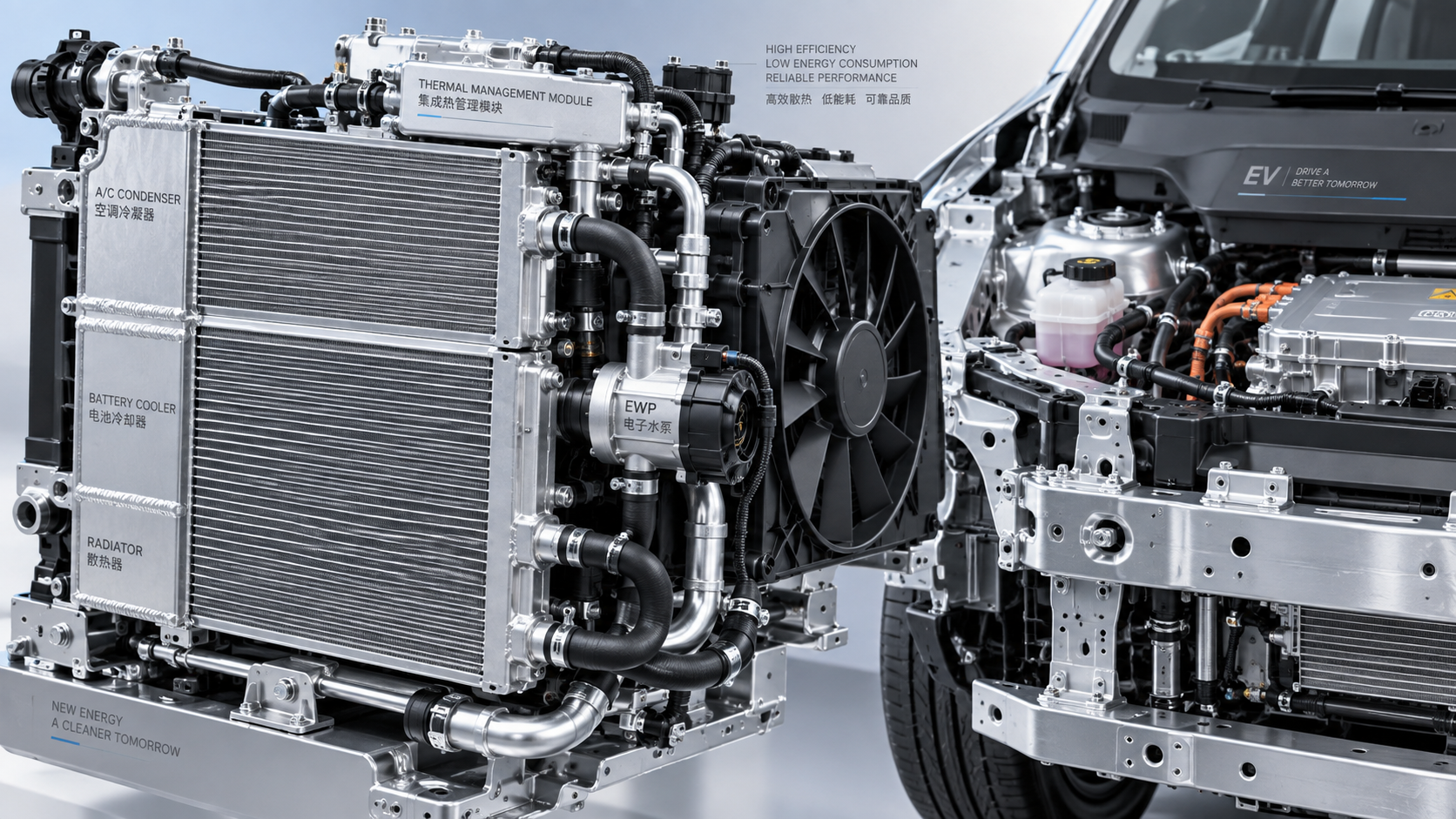
As integrated thermal modules become central to electric vehicle design, New Energy Vehicle Radiator demand is moving away from the familiar idea of a single cooling part mounted at the front of a vehicle. The radiator still matters, but it increasingly works as one element within a coordinated thermal system that may also include a battery chiller, condenser, intercooler, coolant valves, pumps, sensors, and control software.
For business evaluators, this change is more than an engineering detail. It affects sourcing strategy, supplier qualification, cost analysis, production planning, aftermarket opportunities, and long-term program risk. A supplier that is capable of producing a conventional radiator may not automatically be ready to support the tighter packaging, lower tolerance for leakage, multi-circuit design requirements, and documentation discipline associated with new energy vehicles.
The market question is no longer simply, “Who can supply a radiator?” It is increasingly, “Who can deliver a thermal component that performs reliably inside an integrated vehicle cooling architecture?”
Why thermal integration is changing the radiator market
Internal combustion vehicles traditionally concentrate cooling around the engine. Their radiator systems must remove heat from the engine coolant, while separate components handle charge-air cooling, air-conditioning, and transmission cooling. This layout can be complex, yet its functional boundaries are relatively familiar.
Electric and hybrid vehicles introduce a different thermal map. Battery packs operate best within a controlled temperature range. Electric motors, inverters, onboard chargers, and DC-DC converters all generate heat under different duty cycles. Cabin comfort depends on HVAC performance, while fast charging can create a short but intense thermal load. In cold climates, the system may also need to retain or redistribute heat rather than merely reject it.
As a result, vehicle manufacturers are combining cooling functions into integrated thermal modules. These modules can reduce installation complexity, improve energy management, and support more compact front-end packaging. They also place higher expectations on the radiator or heat exchanger assembly: airflow must be managed carefully, coolant paths must be efficient, and the entire module must fit within a crowded vehicle architecture.
This is the primary force behind the evolving New Energy Vehicle Radiator market. Demand is not necessarily defined by a simple increase in the number of standalone radiators per vehicle. Instead, value is shifting toward engineered assemblies with better heat-transfer performance, lighter structures, stronger sealing reliability, and compatibility with adjacent thermal components.
The radiator is becoming a system interface
In an integrated thermal module, the radiator is no longer evaluated in isolation. Its performance influences—and is influenced by—the condenser, fan assembly, shrouds, coolant circuits, mounting brackets, electrical interfaces, and vehicle control strategy.
For example, increasing core density may improve heat rejection under certain conditions, but it can also create higher air-side resistance. That may require changes to fan selection, fan control logic, or module packaging. Likewise, a compact coolant layout can reduce hose length but make service access more difficult. A well-designed component therefore needs to balance thermal output with pressure drop, airflow, weight, assembly feasibility, corrosion resistance, vibration endurance, and repairability.
This system perspective is particularly important for procurement teams that compare quotations only by core size, material grade, and unit price. Those specifications remain relevant, but they rarely capture the full commercial risk. A lower-cost radiator can become costly if it causes rework during module assembly, inconsistent fitment, field leakage, or repeated engineering changes.
Business evaluators should ask whether the supplier understands the interface conditions around the part. Can it work with dimensional envelopes and connection requirements? Can it maintain consistent fin, tube, header, and tank assembly quality over volume production? Can it support design changes without disrupting supply? The answers often matter as much as the initial price.
What is driving demand beyond vehicle sales volume?
New energy vehicle production growth remains an important demand factor, but it is not the only one. Thermal management requirements are becoming more demanding because vehicle designs themselves are changing.
- Higher charging power: Fast-charging conditions can increase the need for controlled battery cooling and efficient heat rejection.
- More electronic content: Power electronics and auxiliary electrical systems add thermal sources that must be managed reliably.
- Compact vehicle platforms: Manufacturers seek integrated front-end solutions that make efficient use of limited packaging space.
- Range and energy-efficiency pressure: Thermal losses can affect vehicle range, especially when HVAC, battery conditioning, and powertrain demands overlap.
- Global climate exposure: A thermal module must operate across hot-weather, cold-weather, high-altitude, dusty, humid, and stop-and-go conditions.
These factors favor suppliers that can produce radiators with controlled manufacturing quality while participating in a broader thermal-management conversation. The opportunity is not limited to passenger EVs. Hybrid vehicles, electric commercial vehicles, buses, construction equipment, and heavy-duty platforms also require increasingly robust cooling solutions, often under harsher operating conditions.
A market split: standardized replacement demand and engineered program demand
It is useful to separate the radiator market into two commercial tracks. The first is standardized replacement or service demand, where established dimensions, vehicle applications, delivery availability, and fitment accuracy are often decisive. The second is vehicle-program demand, where engineering collaboration, validation readiness, production scalability, and integration capability carry more weight.
Both tracks can be attractive, but they require different supplier strengths. In the aftermarket, buyers may prioritize application coverage, catalog accuracy, packaging, and dependable replenishment. For original equipment or platform-development projects, attention moves toward design control, sample consistency, traceability, production process stability, and responsiveness during technical review.
Conventional radiator experience remains valuable in both settings. A product such as the XD6018 RADIATOR FOR NISSAN, with a core size of 665 × 634 mm, illustrates the kind of dimensional discipline and application-specific manufacturing that forms the basis of a strong heat-exchanger portfolio. It should not be treated as a direct proxy for an EV thermal module; rather, it shows why precision in core construction, fitment, and cooling architecture remains fundamental as technologies evolve.
For suppliers, the strategic challenge is to maintain this dependable base while building capabilities for more integrated and technically varied applications.
How business evaluators should assess a New Energy Vehicle Radiator supplier
A productive evaluation goes beyond reviewing a product brochure. It examines whether the supplier can manage the transition from part manufacturing to system-aware manufacturing. The following areas deserve close attention.
1. Thermal design understanding
Suppliers do not always need to own the complete vehicle thermal design, but they should understand the consequences of major choices. Questions about tube geometry, fin configuration, coolant flow paths, pressure drop, air resistance, and heat load should receive clear, technically grounded answers. A supplier that can identify trade-offs early is more likely to prevent late-stage production issues.
2. Manufacturing repeatability
Integrated modules amplify the effect of variation. Small dimensional deviations can complicate assembly with fans, condensers, brackets, or piping. Inconsistent brazing can affect both appearance and long-term durability. Evaluators should look for evidence of controlled production methods, sensible inspection routines, and a practical approach to corrective action—not simply broad claims about quality.
3. Materials and durability management
Radiators face cyclic pressure, vibration, road debris, temperature changes, moisture, and corrosion exposure. New energy applications may introduce different coolant formulations, operating temperatures, or electrical-adjacent design considerations. Material selection and joining processes should therefore be assessed in relation to the intended vehicle environment, not just the lowest procurement cost.
4. Capacity matched with flexibility
Rapid demand growth can make capacity appealing, but capacity without process control creates its own risks. A suitable supplier needs room to scale while maintaining lead-time discipline and stable output. At the same time, it should be able to manage pilot runs, engineering revisions, and mixed-model production when a platform is still developing.
5. Commercial communication across borders
Global sales capability is not only about shipping goods overseas. It includes documentation accuracy, packaging standards, export coordination, response speed, and the ability to clarify technical details across languages and time zones. For a buyer managing multiple sourcing regions, smooth communication can materially reduce project friction.
Common mistakes in radiator sourcing for electrified platforms
One common mistake is treating the thermal module as a collection of unrelated purchased parts. This can lead to interface conflicts that appear only during final assembly. Another is assuming that a larger core always delivers a better result. Heat exchange depends on the full relationship among coolant flow, airflow, fin design, fan performance, vehicle speed, and operating conditions.
Buyers can also underestimate the importance of validation planning. A sample that fits a drawing is not necessarily ready for production. Durability, pressure resistance, thermal cycling, corrosion behavior, and mounting stability all need to be considered within the intended use environment.
There is also a tendency to focus heavily on headline EV technologies while overlooking mature manufacturing fundamentals. Tank sealing, brazing consistency, fixture control, packaging protection, and traceability may sound ordinary, but these details determine whether a thermal component arrives ready for dependable installation.
Where established radiator manufacturers fit into the transition
For companies with a background in water tank radiators, intercoolers, construction machinery radiators, and heavy-truck cooling components, the transition toward new energy thermal modules is not a complete departure. It is an extension of capabilities that already depend on heat transfer, durable construction, application knowledge, and production coordination.
Liaocheng Xinde Auto Parts Co., Ltd., established in 2018, has developed its business around the research, production, and global sale of radiator-related components for heavy trucks, construction machinery, and new energy applications. With registered capital of RMB 5 million and total investment of RMB 50 million, the company represents the type of manufacturer that business evaluators may encounter when mapping China-based supply options: one with experience across conventional cooling categories while expanding toward new energy radiator modules.
Its recognition as a high-tech enterprise and through provincial and municipal honors can be a useful starting point for due diligence, but evaluators should still connect those credentials to the needs of a specific project. The practical questions remain: What application has been quoted? What are the thermal and dimensional requirements? Which production controls apply? What testing evidence is available? How will delivery and communication be managed over the program life?
The next phase of demand will reward disciplined integration
The future of the New Energy Vehicle Radiator market will be shaped less by the disappearance of traditional radiators than by their changing role. Heat exchangers will remain essential, but the most valuable products will increasingly be those designed to work within coordinated thermal systems.
For business evaluators, this creates a clearer sourcing framework. Assess the component, but also assess its interfaces. Review price, but also consider validation, consistency, engineering responsiveness, and logistics reliability. Look for manufacturing experience in demanding cooling applications, while confirming that the supplier can adapt to the tighter requirements of electrified vehicle platforms.
Integrated thermal modules are making the cooling system quieter, more compact, and more technically interconnected. Behind that shift, the radiator remains a critical piece of hardware—one that must now meet a broader set of performance and partnership expectations.