



How to check truck radiator fitment before placing a bulk order
How to Check Truck Radiator Fitment Before Placing a Bulk Order
Before placing a bulk order, procurement teams must verify truck radiator fitment to avoid costly returns, installation delays, and fleet downtime.
A correctly matched truck radiator depends on dimensions, mounting points, hose locations, cooling performance, and accurate vehicle application data.
For buyers of heavy-duty truck, construction machinery, and new energy cooling components, fitment verification is a purchasing control rather than a routine technical detail.
This guide explains how procurement professionals can confirm radiator compatibility, reduce supplier risk, and make dependable bulk purchasing decisions before production begins.
Start With the Correct Vehicle Identification Data
The fastest way to make a wrong purchase is relying only on a vehicle brand, model name, or a supplier's generic application list.
Many truck platforms use different cooling configurations across engine variants, emissions standards, cab designs, production years, and regional markets.
Buyers should collect complete vehicle data before requesting a quotation for any truck radiator, especially when planning a mixed bulk order.
The minimum record should include truck brand, model, chassis number, engine model, production year, transmission arrangement, and destination market.
Where available, the vehicle identification number should be used to retrieve the original parts catalog and confirm the installed cooling system.
For fleet replacement projects, inspect several representative vehicles instead of assuming every truck in the fleet carries the same original radiator.
Previous repairs, engine conversions, accident damage, and aftermarket modifications can create fitment differences within otherwise identical-looking trucks.
Procurement teams should create a vehicle-to-part matrix that lists each application, original radiator number, required quantity, and supporting evidence.
This matrix gives engineering, purchasing, warehouse, and supplier teams one consistent reference throughout inquiry, sampling, production, and delivery.
It also prevents a common problem: ordering by a legacy part number that has been superseded without checking whether the replacement requires related changes.
Confirm OEM Numbers, Cross References, and Part Revisions
OEM numbers are among the strongest fitment references, but buyers must verify them carefully because one number may have multiple historical formats.
Ask the supplier to identify every OEM number, replacement number, and cross-reference number associated with the proposed truck radiator.
Then compare those references with an official parts catalog, dealer documentation, credible aftermarket databases, or a physical label from the removed unit.
Do not treat a matching OEM number as final proof when the radiator has a revision suffix, engineering code, or market-specific designation.
A small change in an OEM reference can indicate a revised core thickness, different transmission oil cooler, altered tank design, or new mounting bracket.
Buyers should request written confirmation explaining whether the offered radiator directly replaces the original part or requires an adapter or modification.
This clarification matters most when sourcing radiators for international markets, where the same vehicle series may use locally specified cooling packages.
For example, a MAN application should be checked against both original equipment references and the physical configuration of the current installed radiator.
The XD81106 RADIATOR FOR MAN is referenced with OEM numbers 81061010079 and 81061016792, providing a useful starting point for application verification.
However, purchasing staff should still validate every vehicle specification before treating an OEM cross-reference as approval for a bulk release.
Measure the Radiator, Not Just the Catalog Description
Physical measurements are essential because catalog descriptions can omit critical features or use dimensions measured from different reference points.
Request a detailed technical drawing for every truck radiator model considered for purchase, preferably with tolerances and measurement reference locations.
The core size should be checked separately from the overall size, because tanks, mounting ears, brackets, and protective frames increase total dimensions.
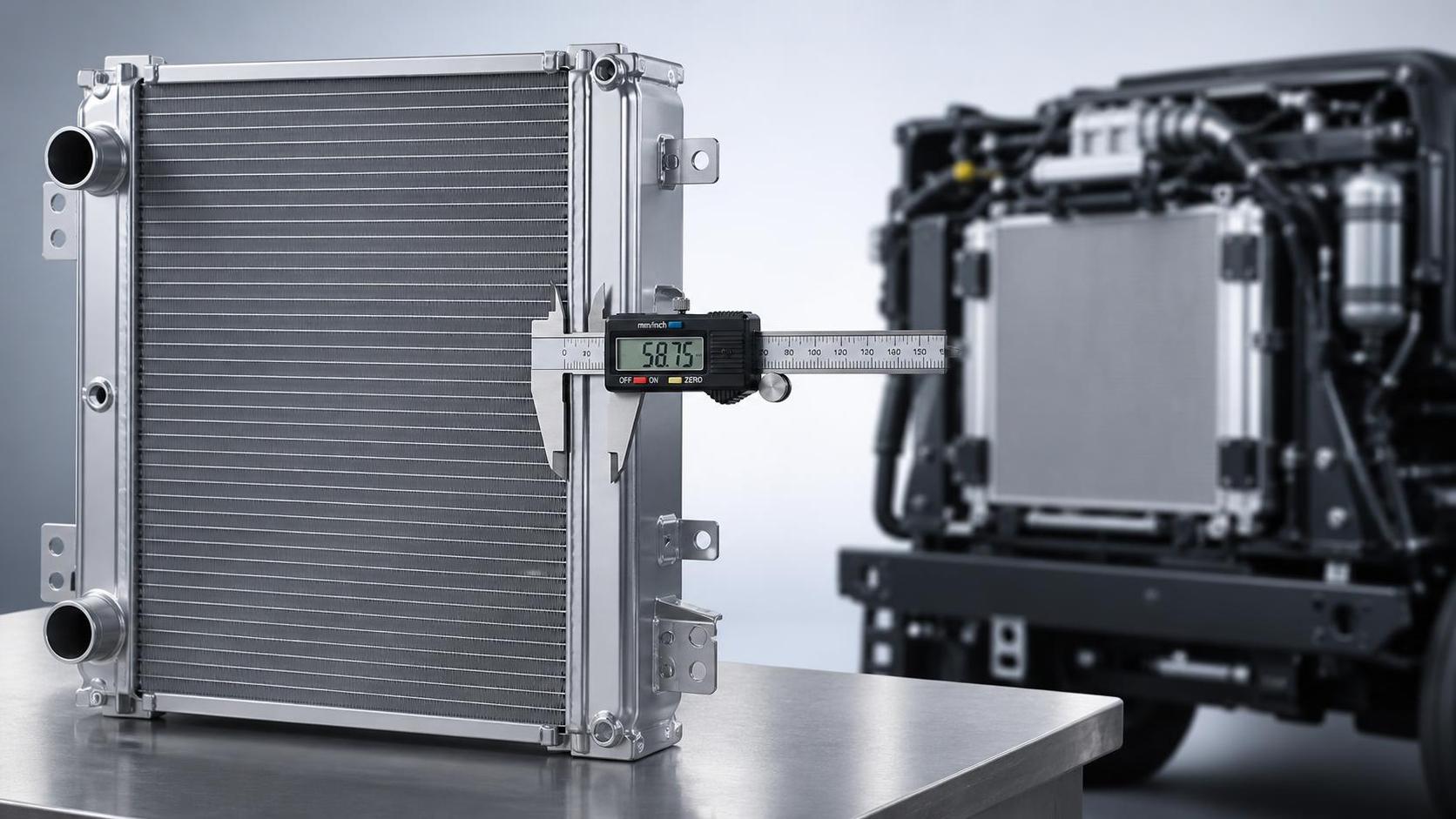
Measure core height, width, and thickness, then compare those figures with the available space in the vehicle cooling module.
Core thickness deserves particular attention because a thicker radiator may interfere with the fan shroud, charge air cooler, condenser, or engine accessories.
The MAN radiator example above has a listed core size of 895 by 934 by 40 millimeters, which must match the installed cooling package.
Do not assume a larger core is automatically an improvement, since restricted airflow or incorrect fan clearance can reduce real cooling performance.
Check the distance between mounting holes, bracket centerlines, upper supports, lower locating pins, and any vibration isolation bushings.
Even a few millimeters of misalignment can force installers to bend brackets, damage plastic tanks, or create long-term stress cracks.
Ask suppliers whether their dimensions are based on finished production parts, prototype drawings, or nominal values copied from an earlier catalog.
Check Mounting Points and Installation Interfaces
A radiator can share the correct core dimensions yet fail installation because its supports, locating pins, brackets, or side frames differ.
Procurement teams should compare the complete installation interface, not only the main cooling core or tank outline.
Photograph the existing radiator from the front, rear, top, bottom, and both sides before sending an inquiry to manufacturers.
Include close-up images of mounting tabs, rubber cushions, upper hooks, lower pins, fan-shroud attachment points, and any integrated support structures.
Each photo should include a ruler or dimension reference whenever possible, particularly for brackets that are difficult to identify in drawings.
Verify whether the radiator sits in a standalone frame or is part of a stacked cooling module with an intercooler, condenser, and oil cooler.
Module-based systems require additional checks because the radiator often supports neighboring heat exchangers through shared clips or brackets.
Construction equipment radiators can have especially complex mounting arrangements due to vibration, dust protection, tilt mechanisms, and confined service access.
Ask the supplier to provide installation photos from previous applications only when those photos clearly show the same interface configuration.
Generic factory photos are useful for assessing manufacturing quality, but they cannot replace a dimensional comparison with the actual truck assembly.
Verify Inlet, Outlet, and Auxiliary Connection Locations
Hose connections are one of the most frequent causes of truck radiator returns because the ports may have similar diameters but different positions.
Confirm the inlet and outlet orientation from the driver's position or another clearly defined vehicle reference, avoiding ambiguous left-right descriptions.
Record the port diameter, neck length, angle, bead profile, and distance from nearby components for both primary coolant connections.
A hose may technically reach an incorrect port location, yet remain twisted, overstressed, or exposed to abrasion during normal engine movement.
Review all auxiliary interfaces, including expansion tank connections, vent ports, drain plugs, temperature sensor ports, and heater return connections.
Some heavy-duty radiators include integrated transmission oil coolers, hydraulic coolers, or other fluid connections that must match the vehicle system.
For these features, compare fitting thread type, sealing method, line orientation, pressure requirement, and clearance for service tools.
Never assume that visually similar fittings are interchangeable, particularly when buying across markets using different thread and hose standards.
Suppliers should provide a port layout drawing with clear labels, dimensions, and photographs showing the finished tank configuration.
This information allows the purchasing team to involve maintenance technicians early, before unsuitable units enter the receiving warehouse.
Match Cooling Capacity to the Actual Duty Cycle
Fitment is not only about whether a radiator installs physically; it must also remove enough heat under the vehicle's real operating conditions.
A truck radiator designed for a lower-power engine or mild climate may fit the frame but fail under high loads.
Buyers should identify engine power, torque rating, operating temperature targets, typical payload, ambient temperature, altitude, and idling duration.
Heavy trucks in mining, construction, port operations, and long-distance haulage can experience far greater cooling demand than standard road applications.
Cooling capacity is influenced by core design, tube geometry, fin density, fin material, coolant flow path, airflow, and fan performance.
Request technical data that supports the supplier's cooling claim instead of accepting phrases such as high efficiency or heavy-duty performance.
Useful evidence can include heat rejection data, pressure-drop information, test conditions, core construction details, and comparison with original specifications.
For new energy radiator modules, confirm battery, motor, inverter, and thermal-management circuit requirements separately from traditional engine cooling requirements.
Different coolant loops can require different flow rates, material compatibility, electrical isolation considerations, and temperature-control tolerances.
If the vehicle operates in extreme conditions, request a sample test or pilot installation before approving a full bulk order.
Assess Material, Construction, and Manufacturing Consistency
Once fitment is confirmed, buyers must evaluate whether every radiator in the bulk shipment will maintain the same approved configuration and quality.
Ask for the material specification of the core, tanks, side plates, brackets, solder, seals, and protective surface treatment.
Aluminum radiators require sound brazing quality, controlled material thickness, durable joints, and corrosion resistance appropriate to the target environment.
Plastic tank radiators also require attention to polymer grade, reinforcement, molding consistency, crimping quality, and thermal aging performance.
For truck applications, vibration resistance is particularly important because poor mounting design or weak joints can cause early leakage.
Review the supplier's pressure-testing process, leak-test criteria, sample inspection records, and methods for controlling dimensional consistency.
It is reasonable to request inspection points for core size, port placement, mounting centers, fin condition, and packaging protection.
Liaocheng Xinde Auto Parts Co., Ltd. manufactures radiators, intercoolers, construction machinery cooling products, and new energy radiator modules for global customers.
When reviewing any manufacturer, buyers should assess whether its production capability and quality controls align with the application and planned order volume.
Certificates and company honors can support supplier evaluation, but measurable product evidence remains more important for fitment approval.
Use Samples and First-Article Approval Before Mass Production
A sample is the most practical way to verify truck radiator fitment when documentation is incomplete, applications are complex, or bulk-order risk is high.
Request a production-representative sample rather than a display sample, because prototype parts may not reflect final tooling, materials, or assembly methods.
Install the sample on the target truck using normal workshop procedures and record any interference, adjustment, or missing hardware.
Check fan clearance, hose routing, mounting engagement, shroud alignment, access to drain points, and separation from moving or hot components.
After installation, inspect coolant circulation, leaks, temperature stability, pressure behavior, and operation under realistic load conditions where feasible.
Document the approved sample with signed photos, dimensional records, part labels, and a clear statement of the approved revision level.
This first-article approval package should become part of the purchase order, preventing accidental substitution after the sample stage.
For recurring procurement, retain one approved master sample or a controlled set of reference measurements at the receiving inspection location.
When a supplier changes tooling, materials, tank molds, core design, or sub-suppliers, require written notice and re-evaluate the change.
Without formal change control, a previously approved truck radiator can gradually drift away from the configuration your fleet or customers require.
Define Bulk Order Quality Terms Before Issuing the PO
A purchase order should specify more than part number, quantity, and price; it should define the technical configuration that was actually approved.
Attach drawings, photos, OEM references, port layouts, core dimensions, mounting dimensions, packaging requirements, and sample approval records to the order.
State the acceptable tolerances for critical dimensions where installation clearance is limited or vehicle-side components vary little.
Include requirements for pressure testing, appearance inspection, labeling, batch traceability, and protection against fin damage during transport.
Packaging is important because bent fins, cracked plastic tanks, and damaged mounting brackets can turn correctly manufactured radiators into unusable inventory.
Specify how each carton should be labeled, including supplier part number, OEM reference, production batch, quantity, and destination-market identification.
For mixed orders, require separate packaging and clear pallet segregation to prevent similar radiator models from being received under the wrong stock code.
Agree on an inspection method before shipment, whether through supplier reports, third-party inspection, buyer attendance, or a combination of controls.
Define the response process for shortages, incorrect fitment, leakage, transit damage, and nonconforming batches before the goods leave the factory.
Clear commercial and quality terms give procurement teams a stronger basis for resolving claims without disrupting urgent maintenance schedules.
Build a Repeatable Fitment Checklist for Future Purchases
A standardized checklist makes radiator sourcing faster and more reliable, especially when multiple buyers handle different brands and vehicle applications.
The checklist should begin with vehicle identity, engine data, original part number, and photos of the installed cooling system.
It should then cover core dimensions, overall dimensions, mounting points, port positions, hose diameters, auxiliary connections, and cooling requirements.
Add supplier documentation checks, sample status, quality records, packaging specifications, and purchase-order attachments to complete the approval process.
Assign responsibility for each check so purchasing staff do not assume engineering, maintenance, or suppliers have already verified the same item.
For high-value orders, require a final cross-functional review involving procurement, technical staff, quality control, and warehouse receiving personnel.
This review is particularly valuable when purchasing radiators for unfamiliar vehicle platforms, export markets, or equipment with limited parts documentation.
Keep approved records organized by part number and application, allowing future orders to use verified data rather than rebuilding the investigation.
Over time, this database can reveal recurring supplier issues, application risks, warranty patterns, and opportunities to consolidate reliable truck radiator sources.
It also gives procurement managers better visibility into the financial impact of fitment accuracy across inventory, service levels, and fleet uptime.
Conclusion: Treat Fitment Verification as a Bulk-Order Gate
Reliable truck radiator purchasing starts with a simple principle: no bulk order should proceed until both physical fitment and thermal suitability are verified.
Vehicle data, OEM references, accurate measurements, mounting interfaces, port layouts, and cooling requirements must all point to the same approved configuration.
Samples and first-article approval provide the strongest protection when catalogs conflict, applications are specialized, or the cost of downtime is high.
By documenting the approved radiator specification in the purchase order, buyers reduce installation problems, returns, warranty claims, and avoidable inventory losses.
For procurement teams, a disciplined fitment process turns truck radiator sourcing from a price comparison exercise into a controlled purchasing decision.