



Are aftermarket truck radiators suitable for heavy-duty towing?
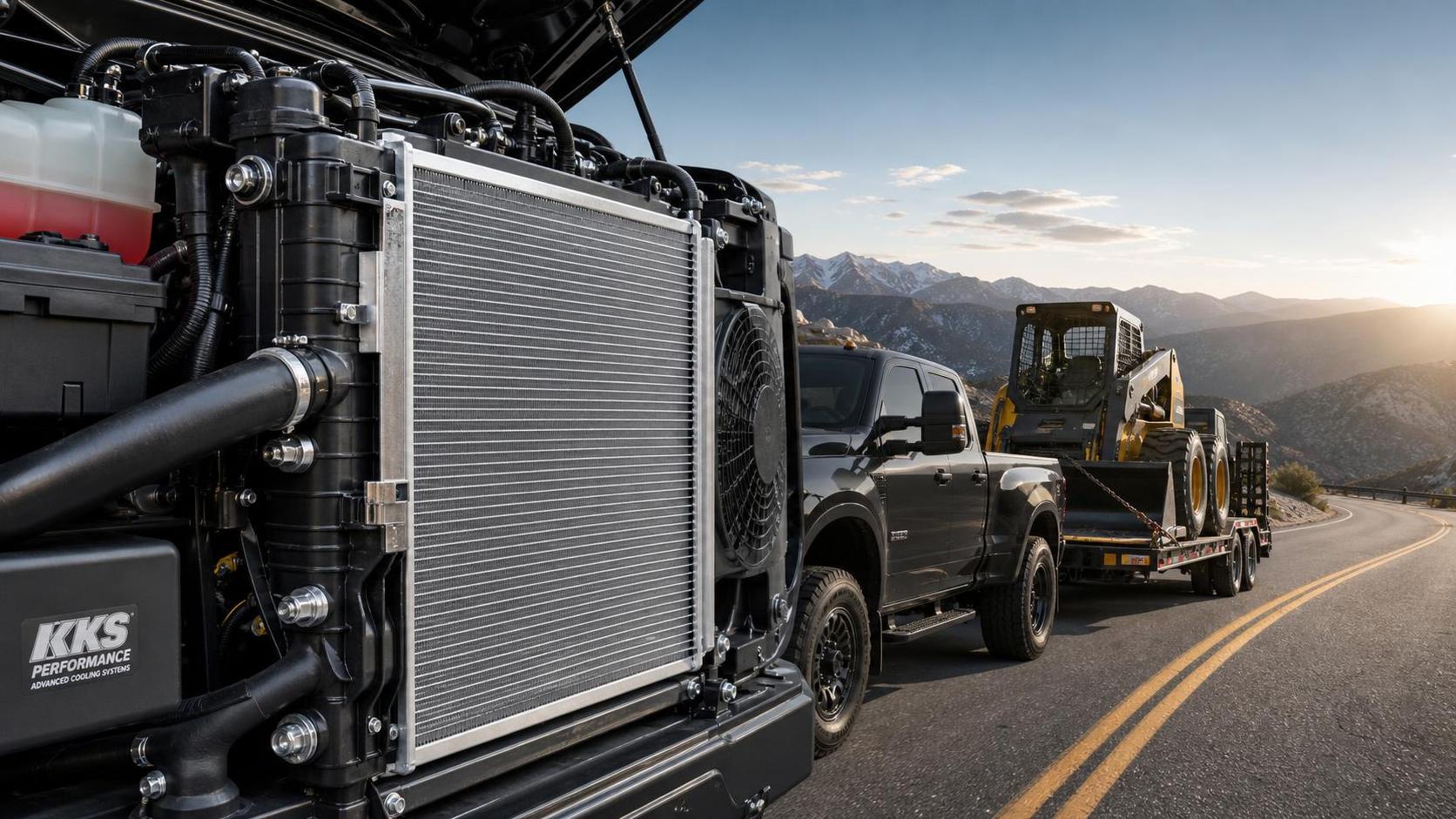
Yes, an aftermarket truck radiator can be suitable for heavy-duty towing, but suitability depends on whether its thermal capacity, construction, fitment, and validation match the vehicle's actual duty cycle. A replacement that merely fits the mounting points may be adequate for ordinary driving yet lose temperature control during long grades, high ambient temperatures, stop-and-go hauling, or sustained high engine load. Heavy-duty towing exposes weaknesses that remain hidden in lighter service.
The radiator must reject heat continuously rather than only absorb a short temperature rise. When the cooling system has little reserve, coolant temperature may climb during a pull, the fan may remain engaged for long periods, charge-air temperatures may increase, and engine protection strategies may reduce available power. Repeated thermal stress can also affect hoses, seals, plastic tanks, transmission cooling circuits, and adjacent components. The correct replacement decision therefore starts with the complete cooling requirement, not with the lowest-priced part number.
Cooling Capacity Must Match the Towing Load
A truck radiator transfers heat from coolant to air through its tubes, fins, and core. Its performance is influenced by frontal area, core thickness, tube geometry, fin density, coolant flow, airflow through the core, and the temperature difference between coolant and incoming air. Towing changes several of these conditions at once. Engine heat generation rises, vehicle speed may fall on climbs, and high outside temperatures reduce the temperature difference available for heat rejection.
An aftermarket unit may perform well when it preserves the original equipment cooling envelope. This usually means the core dimensions and tube count are not reduced, the fin arrangement is appropriate for the vehicle, and internal restrictions do not impair coolant circulation. A radiator with a thinner core or fewer cooling tubes can look similar from the outside while offering less heat-transfer surface. Conversely, a substantially denser fin pack is not automatically better. Very tight fin spacing can impede airflow when dirt, insects, mud, or road debris accumulates, particularly where the fan must pull air through several heat exchangers.
Catalog descriptions often emphasize overall dimensions. Those dimensions matter, but they are insufficient on their own. Two truck radiator assemblies of the same height and width may have different tube widths, core depths, fin profiles, tank designs, or transmission-cooler configurations. The towing application must be evaluated against the original cooling package and any factory tow preparation, rather than against exterior measurements alone.
Core Construction Reveals More Than Appearance
Most modern truck radiators use aluminum cores because aluminum combines relatively low weight with effective heat transfer. The quality question is not simply whether aluminum is present. Tube-wall consistency, fin bond quality, header design, braze integrity, and corrosion protection all affect service behavior. Thin material can reduce weight and cost, but it may be less tolerant of pressure cycling, vibration, debris strikes, and repeated temperature changes if the overall design is not properly engineered.
Plastic end tanks are common and can be reliable when the resin, molding process, seal groove, crimp geometry, and reinforcement are correct. Their presence alone is not a reason to reject a part. However, tank-to-header joints deserve close attention because they are exposed to pressure pulses and thermal expansion. Look for uniform crimps, consistent gasket seating, no sharp deformation around the header, and fittings that are firmly located without distortion. An all-metal construction may be preferred in certain repair strategies, but material type should not replace a review of the complete assembly.
Tube layout is particularly relevant under prolonged towing load. Wider tubes can offer coolant-flow advantages, while multi-row or thicker cores can increase heat-transfer area. Either approach can be effective if it works with the fan, shroud, condenser, charge-air cooler, and grille opening. Installing a thicker radiator without confirming clearances can create contact with the fan shroud, interfere with charge-air piping, or shift the core away from sealing surfaces that direct airflow.
Airflow Is Part of the Radiator Specification
Many apparent radiator failures are airflow failures. A heavy-duty towing truck may have an air-conditioning condenser, intercooler, oil cooler, transmission cooler, and radiator arranged in a stack. Dirt lodged between these layers can restrict airflow while leaving the front face looking relatively clean. Bent fins, missing foam seals, damaged shrouds, weak fan clutches, faulty electric fan control, and unsealed gaps around the core can all reduce cooling capacity.
Before replacing a truck radiator because of high temperature, the cooling stack should be inspected from both sides where access allows. The fan should pull air through the intended core area rather than around its edges. A shroud that is cracked, poorly positioned, or omitted after service can noticeably change low-speed cooling. For electronically controlled fans, diagnosis should include command signals, fan speed behavior, relays, connectors, and relevant temperature inputs. Replacing the radiator alone will not correct a fan that fails to deliver airflow during a slow uphill pull.
Air-side restriction also affects the choice of fin density. A vehicle used on paved routes with regular cleaning may tolerate a different fin design from one operating around dust, agricultural debris, construction material, or unpaved access roads. The appropriate design is the one that balances heat transfer with serviceability in the actual environment.
Fitment Includes Every Connection and Clearance
Heavy-duty towing makes small fitment errors expensive. The radiator must locate securely in the upper and lower mounts, sit squarely in the support, and maintain designed clearance to the fan, shroud, condenser, and charge-air cooler. Isolators should be present and in usable condition. A core mounted under twist or compression can develop stress at the tanks, headers, or brackets as the chassis and powertrain move.
Connection details require the same scrutiny. The upper and lower hose diameters, neck angles, overflow port, drain location, sensor bosses, cooler line ports, and mounting tabs must correspond to the vehicle configuration. A nominally compatible assembly may omit an integrated transmission cooler or use ports with a different thread, depth, or sealing method. Adaptors can introduce leak paths and should be evaluated carefully, especially where hot transmission fluid is involved.
Part-number matching should be supported by physical comparison when the vehicle has unusual equipment, a replacement engine, modified front-end components, or an added towing package. Radiator applications are often separated by engine variant, transmission arrangement, cooling package, or production change. The vehicle identification details, original unit measurements, hose routing, cooler ports, and mount layout should all agree before installation.
The same discipline applies when reviewing a smaller passenger-vehicle component such as an AUDI A3 Radiator, but a truck towing application has less room for a marginal capacity or fitment mismatch because the sustained thermal load is far higher.
Testing Evidence Should Be Specific
An aftermarket radiator should arrive as a sound, pressure-tested assembly, but a pressure test is only one part of the assessment. It confirms the integrity of the assembled unit at the test condition; it does not by itself prove equivalent cooling performance over a long towing cycle. Useful technical information may include core dimensions, tube and fin configuration, material specification, pressure-test process, cooler details, and vehicle application coverage.
Claims such as “heavy duty” or “high performance” need a defined basis. The term may refer to a thicker core, reinforced tanks, altered tube design, or simply a supplier's product category. Without construction details and application context, the label does not establish suitability. A part with a claimed upgrade core may still be unsuitable if its mounts, shroud interface, hose positions, or cooler arrangement differ from the original system.
After installation, the system should be filled with the correct coolant type and concentration, bled according to the vehicle procedure, and checked for leaks at operating temperature. Air pockets can imitate an undersized radiator by interrupting coolant flow and causing temperature swings. The heater circuit, thermostat operation, pressure cap condition, water pump behavior, and hose integrity should also be considered. A restricted thermostat or a deteriorated pressure cap can produce symptoms incorrectly blamed on the new radiator.
Common Procurement Errors
The most frequent error is treating the radiator as an isolated commodity. It is one component of a controlled airflow and coolant-flow system. Selecting solely by low price or general vehicle fitment can result in repeated labor, unplanned downtime, and additional diagnostic work when the part does not match the actual towing duty.
- Comparing only overall width and height while ignoring core depth, tube pattern, and integrated cooler connections.
- Assuming an all-aluminum appearance proves a higher heat-rejection capacity without reviewing the internal core design.
- Reusing damaged mounts, old clamps, collapsed hoses, or a weakened cap during a radiator replacement.
- Installing a replacement before cleaning the condenser and cooler stack, then attributing continued overheating to the new part.
- Ordering against a broad model description when the vehicle has an engine, transmission, or cooling-package variation.
Packaging and transport also matter. Bent fins, crushed corners, damaged hose necks, and distorted mounting tabs can occur before installation. The radiator should be inspected before it is fitted, because minor shipping damage may affect sealing, airflow, or alignment. Protective caps should remain in place until connection, preventing dirt from entering cooler ports and coolant passages.
When an Aftermarket Unit Is a Reasonable Choice
An aftermarket truck radiator is a reasonable choice for heavy-duty towing when the supplier can identify the exact application, the core construction is appropriate for the original cooling package or a documented higher-duty configuration, and the assembly retains the required fittings and mounting geometry. The surrounding cooling system must be in serviceable condition. These conditions matter more than whether the part is sold under an original-equipment channel or an aftermarket channel.
Where the vehicle regularly approaches its cooling limit, a closer review is justified before selecting any replacement. Factors such as terrain, trailer mass, ambient temperature, idling time, load duration, front-end airflow restrictions, and added auxiliaries may indicate that the original specification is already being used at the edge of its intended range. In that situation, a replacement should not have reduced core capacity, and any upgraded design should be checked for airflow, fitment, and cooling-system compatibility.
The strongest basis for selection is a documented match between vehicle configuration, radiator construction, and operating conditions. A truck radiator that meets those conditions can support demanding towing work; one selected only because it physically fits may introduce a thermal risk that becomes visible only when the load is at its highest.