



How Radiator Core Thickness Changes Cooling Results
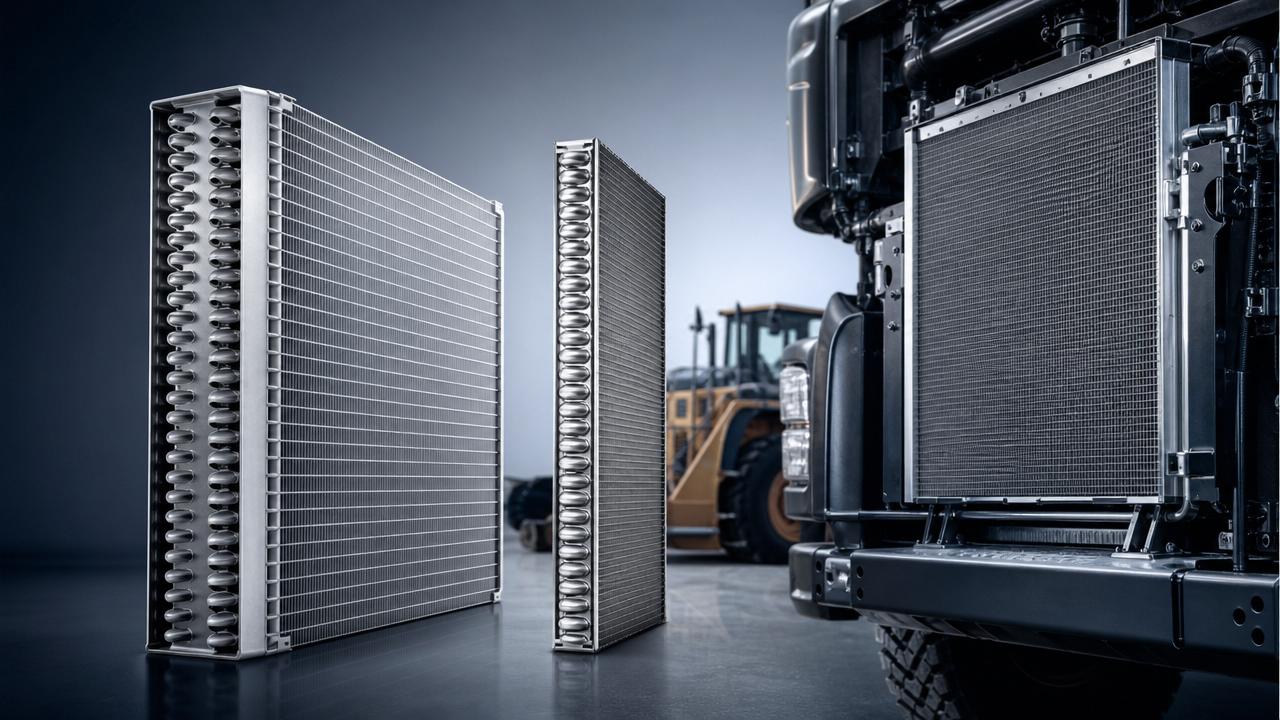
How Radiator Core Thickness Changes Cooling Results
For technical evaluation, radiator core thickness is not just a dimensional detail. It changes heat rejection, airflow resistance, coolant behavior, and long-term cooling consistency.
A thicker radiator core can increase cooling capacity in some systems. In other cases, it raises restriction and weakens performance when airflow or fan power is limited.
That is why radiator core selection should be based on operating load, packaging space, duty cycle, and contamination risk. The wrong thickness can create unstable temperatures and unnecessary service issues.
This article explains how radiator core thickness changes cooling results, what to check before selection, and where thickness has the biggest impact across heavy-duty applications.
Why a Structured Evaluation Matters
Cooling systems rarely fail because of one number alone. Radiator core thickness interacts with tube design, fin density, fan capability, coolant flow, and vehicle operating environment.
A structured review helps compare radiator core options under real thermal conditions. It also reduces the risk of overbuilding the core and accidentally hurting airflow efficiency.
In parts engineering, especially for heavy trucks and machinery, a radiator core should be judged as a heat exchanger system rather than a simple thicker-is-better component.
Core Checks Before Choosing Radiator Core Thickness
- Confirm the actual heat load at peak operation, including ambient temperature, engine output, idling periods, grade climbing, and auxiliary thermal demand from nearby modules.
- Check available airflow first. A thicker radiator core may add surface area, but poor air penetration can reduce effective heat transfer through deeper fin passages.
- Measure fan performance against pressure drop. If the fan curve cannot overcome added resistance, cooling results may decline despite a larger radiator core.
- Review coolant-side pressure loss. More rows or deeper tubes can change flow distribution and may create hot zones if pump capacity is already limited.
- Compare fin density and tube geometry with thickness. A well-designed thinner radiator core can outperform a thicker core with poor internal and external flow balance.
- Assess contamination exposure. Dust, mud, insects, and oily particles reduce airflow more quickly in deeper cores, especially in construction and off-road environments.
- Verify package constraints around shrouds, charge air coolers, condensers, and guards. Core thickness affects stack spacing and the thermal behavior of the full module.
- Examine service life targets. Thermal performance on day one matters, but stable cooling after fouling, vibration, and repeated heat cycling matters even more.
How Radiator Core Thickness Influences Cooling Results
1. Heat Transfer Surface Increases
A thicker radiator core usually adds more tube and fin area. That can improve heat rejection when air and coolant both move efficiently through the entire depth.
This benefit is strongest when thermal load is high and the fan system has enough static pressure reserve. Otherwise, added depth becomes underused surface area.
2. Airflow Resistance Rises
As radiator core thickness increases, air must pass through more fin material and a longer flow path. This increases pressure drop on the air side.
If the fan, shroud, or vehicle speed cannot support that resistance, airflow falls. Lower airflow often cancels out the expected cooling gain from a thicker radiator core.
3. Coolant Distribution Can Change
Core depth affects tube count, path length, and internal flow behavior. Uneven coolant distribution can leave some sections colder and others overloaded.
Good radiator core design balances header layout, tube dimensions, and pump characteristics. Thickness alone does not guarantee uniform thermal performance.
4. Fouling Sensitivity May Increase
In dusty duty cycles, a deeper radiator core may trap debris more easily across multiple fin layers. Cleaning also becomes harder if contamination penetrates beyond the front face.
For harsh service, slightly lower depth with stronger airflow retention can outperform a thicker radiator core after months of real-world exposure.
Application Notes for Different Operating Scenarios
Heavy Trucks
Long climbs, high gross weight, and low-speed pulling create sustained heat load. Here, radiator core thickness must be matched to fan capacity and coolant flow reserve.
When frontal area is limited, a thicker radiator core may help. However, road dust and multi-module cooling stacks must still be considered carefully.
Construction Machinery
Construction machinery often faces mud, sand, low-speed operation, and severe vibration. In this setting, airflow retention after fouling is often more important than maximum clean-core performance.
A radiator core that is too thick may clog faster. Service access, cleaning frequency, and core robustness should guide the final thickness decision.
New Energy Thermal Modules
Battery systems, power electronics, and electric drive units need stable temperature control. These systems may prefer tighter thermal consistency over peak one-point cooling output.
In integrated modules, radiator core thickness must work with compact packaging and low-noise airflow strategies. Balanced resistance becomes especially important.
Public Transportation Buses
For bus platforms, reliability and uptime are critical. A solution such as Radiator for Ankai can support public transportation with premium-grade aluminum construction.
With advanced brazing technology, this type of radiator supports thermal management for diesel and new energy electric buses while helping reduce downtime and protect component life.
Commonly Overlooked Risks
Assuming more thickness always means better cooling is a frequent mistake. Once airflow collapses, extra radiator core depth adds cost and mass without delivering stable results.
Testing only in clean conditions can also mislead decisions. A radiator core should be evaluated under fouled, hot, low-speed, and peak-load states.
Another risk is ignoring the full cooling stack. Condenser placement, intercooler resistance, grille design, and fan shroud sealing all affect radiator core performance.
Material quality matters as well. Premium aluminum construction and reliable brazing influence durability, leak resistance, and long-term heat transfer consistency.
Practical Execution Suggestions
- Start with thermal duty, not catalog thickness. Define worst-case operating heat, target outlet temperature, and allowable pressure drop.
- Compare at least two radiator core depths with fan curve data. Validate airflow, not just theoretical surface area.
- Evaluate dirty-core performance early. Simulated fouling often changes the best radiator core selection.
- Review module integration, including intercooler, condenser, shroud, and guard spacing before freezing core thickness.
- Use durability criteria alongside cooling data. Vibration strength and braze quality affect real service value.
Final Takeaway
Radiator core thickness changes cooling results through a balance of heat transfer area, airflow resistance, coolant distribution, and contamination behavior. The best radiator core is the one matched to the whole system.
For parts selection in trucks, machinery, and bus thermal systems, compare thickness options with real operating data rather than assumptions. That approach improves reliability, thermal stability, and lifecycle performance.
Liaocheng Xinde Auto Parts Co., Ltd. focuses on radiator, intercooler, and thermal module development for heavy-duty and new energy applications. Its experience in research, production, and global supply supports more accurate cooling component matching.
Before the next design or replacement decision, review airflow limits, fouling risk, and duty cycle together. That is the most reliable way to choose the right radiator core thickness.