



Does a thicker truck radiator always improve cooling capacity?
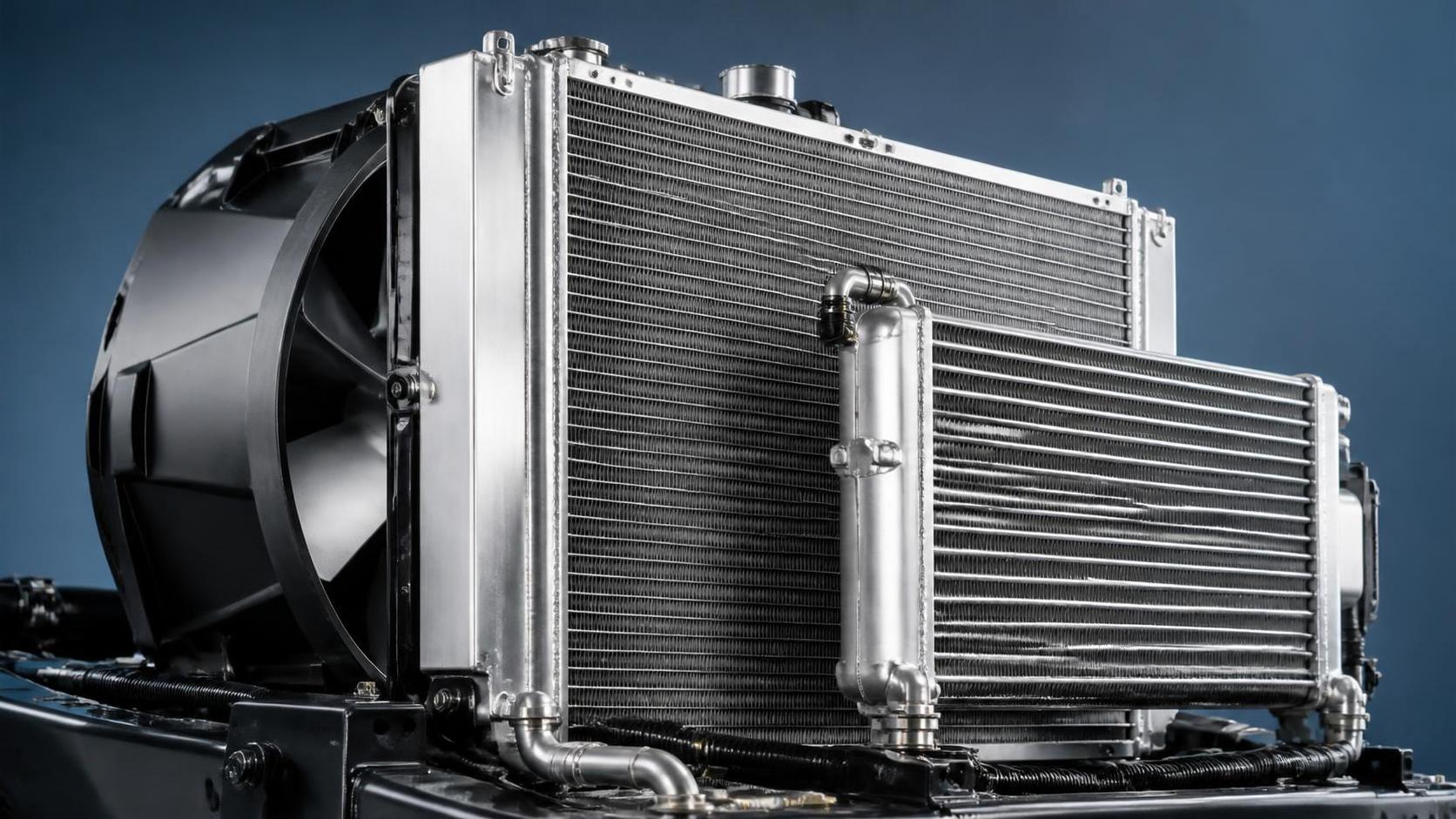
A thicker truck radiator does not automatically deliver better cooling capacity. Core thickness can add heat-transfer area, but it can also restrict airflow, increase fan power demand, and reduce real cooling performance if the tube, fin, coolant-flow, and vehicle-airflow design are not matched. The right question is not “How thick is the core?” but “Can this complete radiator system reject enough heat at the vehicle’s worst operating condition?”
That distinction matters in heavy-duty trucks. A radiator that performs well during a stationary workshop test may struggle on a slow construction haul, a high-ambient climb, or a dusty site where fin blockage develops quickly. Thickness is visible and easy to compare on a drawing. Cooling margin is not.
Why truck radiator thickness is only one part of cooling performance
A radiator transfers heat through several stages: heat moves from engine coolant to the tube wall, through the tube material, into the fins, and then from the fins into the air passing through the core. Increasing core thickness usually adds tube rows or increases the air-side heat-transfer path. In a well-designed system, that can raise heat rejection capacity.
But air does not move through a thicker core for free. More core depth generally creates more airflow resistance. If the existing fan, shroud, grille opening, charge-air cooler, condenser, and under-hood layout cannot maintain adequate airflow, the extra rear rows of a thick core may operate less effectively than expected. In some installations, the added thickness produces a smaller gain than the specification sheet suggests. In poorly matched installations, it can even make high-load cooling worse.
There is another practical issue: air reaching the front of the radiator is rarely uniform. The fan creates a pressure field, nearby components block portions of the face area, and road speed changes airflow direction and volume. A deep core can only use its additional surface efficiently when air distribution across the full core is controlled.
Direct answer: a thicker core is beneficial when the truck has sufficient airflow, appropriate fin geometry, adequate coolant flow, and packaging space for the complete cooling stack. It is not a universal upgrade, and core depth alone should never be used as the acceptance criterion for a truck radiator.
What actually determines truck radiator cooling capacity
Technical evaluations should consider the core as a heat exchanger rather than a single dimension. The following factors often have more influence than a small increase in thickness.
Tube design and coolant-side flow
Tube width, height, wall thickness, internal geometry, pitch, and number of tubes affect both heat transfer and pressure drop. A modern wide-tube design may provide useful coolant contact area with fewer joints and lower resistance than a narrow multi-row layout. The best arrangement depends on pump capacity, coolant flow rate, engine heat rejection, and the allowable pressure drop across the radiator.
Adding rows without checking the water side can create a restrictive circuit. Higher pressure drop can reduce flow through the system, particularly when the water pump is near its operating limit. The result may be localized high temperatures in the cylinder head or exhaust-side areas even when the radiator itself looks larger.
Fin density is a trade-off, not a maximum-value target
More fins per inch add air-side surface area, which sounds positive. Yet dense fins also increase air resistance and are more sensitive to dust, insects, mud, chaff, and oil contamination. Heavy trucks operating in mines, farms, ports, timber yards, and construction environments often need a fin design that preserves cleanability and airflow after service exposure, not merely the highest initial laboratory heat-transfer figure.
A fin pattern with slightly lower density but stable airflow after contamination may provide better seasonal performance. This is one reason an evaluator should ask for the intended duty cycle before approving a “higher-capacity” radiator.
Airflow through the complete cooling package
The radiator does not work in isolation. On many trucks, air passes through a grille, condenser, charge-air cooler, transmission cooler, or hydraulic cooler before reaching the radiator. Each component adds restriction and raises inlet-air temperature for the next component.
At highway speed, ram air can make a large contribution. At low vehicle speed, fan performance becomes decisive. A radiator selected for long-distance road service may not be suitable for a truck that spends hours crawling uphill with a loaded trailer. Fan diameter, blade design, shroud coverage, clutch calibration, electric-fan control logic, and leakage paths around the core all need review.
A common mistake is to compare only radiator face area and depth while ignoring whether the fan shroud seals to the new core. Even a good truck radiator can lose a significant share of useful airflow when air bypasses the fins through gaps around the shroud or support frame.
When a thicker core is the correct choice
There are legitimate cases where more depth is the right engineering decision. A thicker core can help when the original system has confirmed thermal shortfall under sustained high-load operation, the fan has enough pressure capability, and the cooling stack can accommodate the added restriction. Applications with higher engine output, hot-climate operation, continuous PTO loads, or upgraded towing demand may need additional heat-rejection capacity.
It is most defensible when the upgrade is supported by operating data. Useful evidence includes coolant outlet temperature, engine inlet temperature, ambient temperature, vehicle speed, fan engagement state, charge-air temperature, and test duration under representative load. The test should reproduce the condition that causes the complaint. A brief idle test on a mild day does not validate a cooling package intended for a fully loaded climb.
Core thickness is also more likely to help when the original radiator has sufficient face area and airflow but limited tube-and-fin surface. In that situation, the extra depth may provide a meaningful thermal margin without overwhelming the air system. This must still be verified through pressure-drop and airflow assessment rather than assumed from dimensions.
When a thicker core can be the wrong solution
A thicker radiator is often the wrong response when overheating is caused by a system fault or an airflow problem. Replacing a standard core with a deeper one will not correct a slipping fan clutch, blocked condenser, damaged shroud, wrong thermostat, weak water pump, collapsed hose, incorrect coolant mixture, trapped air, or combustion-gas intrusion into the cooling circuit.
It can also be unsuitable where installation space is tight. Moving the radiator rearward may reduce clearance to the fan. Moving it forward can compromise the charge-air cooler, grille airflow, mounting stiffness, or service access. Vibration and thermal expansion should be checked as carefully as nominal dimensions. A truck radiator that fits between the frame rails but has poor mount isolation is not an acceptable heavy-duty solution.
For vehicles working in dirty environments, excessive depth combined with tight fin spacing can make cleaning difficult. Debris tends to remain between stacked heat exchangers, where it is hard to see from either side. In that case, better sealing, an improved pre-cleaning routine, a revised fin configuration, or more frontal area may be more valuable than additional core depth.
How to assess a radiator beyond the catalogue dimensions
Before approving a replacement or upgrade, establish the operating envelope. Record the engine rating, expected continuous load, ambient-temperature range, altitude, vehicle speed profile, towing or PTO duty, and the heat exchangers installed ahead of the radiator. A specification that works for regional road transport may not carry over to a mixer, tipper, crane truck, or construction machine.
Then compare the actual radiator design, not only the outside size:
- Core face area and depth, including the usable fin area rather than only tank-to-tank dimensions.
- Tube count, tube section, pitch, and internal coolant passage design.
- Fin type, fin pitch, louver geometry, and contamination tolerance.
- Coolant-side and air-side pressure drop at relevant flow conditions.
- Material grade, brazing quality, tank construction, and mounting provisions.
- Compatibility with fan shroud, fan clearance, hose routing, sensors, and adjacent coolers.
- Serviceability, including access for cleaning and pressure testing.
This is also where replacement parts need disciplined identification. A part may share a similar outline yet differ in hose positions, mounting tabs, transmission-cooler connections, sensor ports, or core specification. For a MAN application, the dimensions alone are not a complete interchangeability check. A listing such as radiator for man xd046-1, identified with models XD046-1 and 81061016407 and a stated size of 945 × 688 × 48 mm, should be verified against the vehicle’s original part number, cooling-stack arrangement, and installation details before procurement.
Use temperature data correctly
Cooling decisions are frequently distorted by looking at one dashboard temperature reading. The useful measurement is the thermal behavior of the system under controlled load. Track coolant temperature rise across the engine and drop across the radiator where practical, together with ambient temperature and airflow conditions. If the thermostat is regulating normally, a stable coolant reading alone does not prove that the radiator has excess capacity; it may simply mean the test was not demanding enough.
Likewise, a high coolant temperature does not prove radiator insufficiency. If radiator inlet temperature is high but the air-side temperature difference is weak, the problem may be airflow. If coolant flow is inadequate, the radiator may not receive heat in the intended way. If the radiator is rejecting heat effectively but engine temperature still climbs, the root cause can sit upstream in the engine or circulation circuit.
Evaluators should distinguish between a short, recoverable temperature rise and sustained overheating that persists after fan engagement or increased road speed. The latter points more strongly to a true heat-rejection or system-flow limitation.
Material quality and build consistency still matter
Aluminum radiator performance depends on more than alloy selection. Tube and fin bonding, brazing consistency, header design, tank sealing, and corrosion control affect long-term heat transfer and durability. A core may look substantial when new but lose capacity after internal deposits, external fin damage, or repeated thermal cycling.
Supplier capability is therefore part of technical evaluation. Liaocheng Xinde Auto Parts Co., Ltd., established in 2018, develops and manufactures water tank radiators, intercoolers, construction machinery radiators, and related components for heavy trucks and new-energy radiator modules. For a project review, the useful conversation is not simply whether a supplier can offer a thicker core. It is whether it can confirm the core configuration, production controls, dimensional consistency, pressure-test requirements, and application-specific validation needed for the intended vehicle.
Claims about capacity should be tied to test conditions. Ask what inlet coolant temperature, coolant flow, inlet-air temperature, airflow rate, pressure drop, and test standard were used. If those conditions are unknown, quoted performance figures should be treated as comparative information rather than a final acceptance value.
A practical selection rule
Choose a truck radiator based on required heat rejection at the worst credible duty point, with a realistic allowance for airflow restriction and service contamination. Select more core thickness only when it supports that requirement without creating unacceptable pressure drop, fan-clearance issues, packaging conflicts, or maintenance burden.
For a direct-fit replacement on a standard vehicle, matching the original validated configuration is usually safer than pursuing a thicker core. For an altered or severe-duty application, start with measured thermal data and a complete cooling-package review. That approach produces a defensible decision, avoids unnecessary component changes, and is far more reliable than treating thickness as a stand-alone measure of truck radiator quality.
Frequently asked questions
Is a three-row radiator always better than a two-row radiator?
No. A two-row core with wider, well-designed tubes may outperform a three-row core in some applications. Compare heat rejection, coolant pressure drop, airflow restriction, and packaging compatibility rather than row count alone.
Will a thicker radiator lower engine temperature immediately?
Only if radiator heat-rejection capacity is the real limiting factor. If the fault is poor fan operation, a blocked cooling stack, low coolant flow, or an engine-side issue, temperature may not improve.
Should fin density be increased for hot climates?
Not automatically. Hot-climate service may benefit from more air-side area, but dense fins can reduce airflow and foul faster in dusty conditions. The correct choice depends on fan capability and the operating environment.
What should be checked before approving an aftermarket radiator?
Confirm part-number compatibility, mounting points, hose and sensor connections, fan clearance, core dimensions, cooling-stack layout, pressure-test requirements, and the supplier’s stated validation conditions.
Can a larger radiator compensate for an undersized fan?
Usually not at low speed. A larger or thicker core still needs air moving through it. In low-speed, high-load service, fan and shroud performance may be the limiting factor.
Suggested internal links
- Heavy-duty radiator core design: technical guide to tube, fin, and core selection
- How to diagnose truck overheating: cooling-system inspection checklist
- Intercooler and radiator stack design: managing airflow restriction
- Radiator pressure testing and leak inspection: workshop procedures
- MAN truck radiator part-number matching: fitment verification guidance
Suggested external reference directions
- Heavy-duty truck manufacturer official service manuals and cooling-system technical documentation
- SAE technical papers covering vehicle thermal management, heat exchangers, and fan-system performance
- Academic or laboratory research on automotive radiator heat transfer, air-side pressure drop, and fouling effects