



DAF MAN Radiator Types: Copper-Brass vs Aluminum for Commercial Vehicles
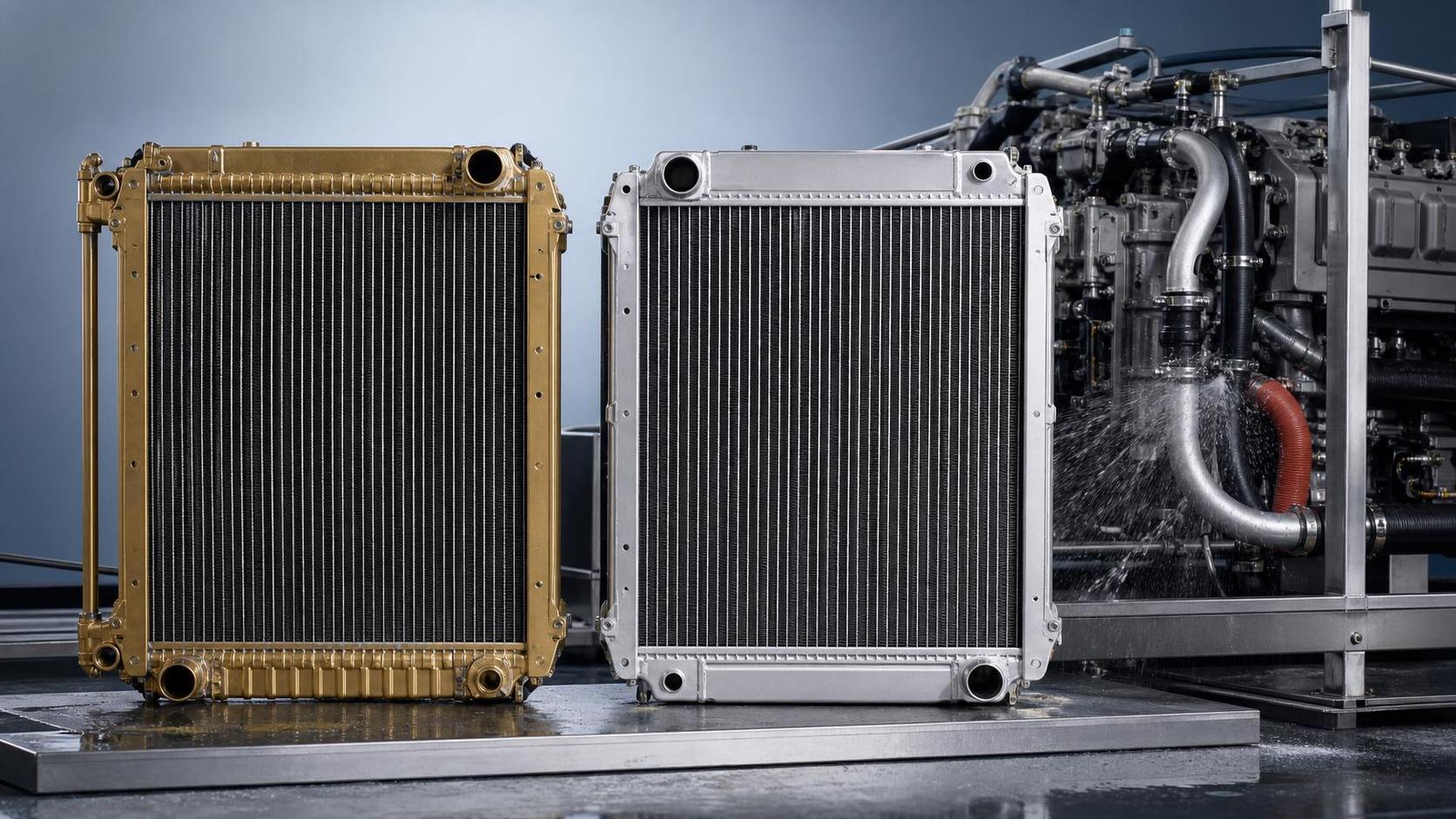
DAF MAN Radiator Types: Copper-Brass vs Aluminum for Commercial Vehicles
Choosing the right DAF MAN Radiator material can directly affect cooling efficiency, service life, and fleet operating costs.
When copper-brass and aluminum are compared, the answer is rarely universal.
Duty cycle, road conditions, ambient temperature, maintenance capability, and repair strategy all shape the better option.
For technical evaluation, material choice should be linked to measurable operating outcomes, not just unit price.
A DAF MAN Radiator in regional haul service may need different priorities than one used in mining, construction support, or cross-border freight.
This guide breaks down the practical differences between copper-brass and aluminum designs for heavy-duty cooling systems.
Why Material Choice Matters in a DAF MAN Radiator
A radiator is not just a heat exchanger.
In commercial vehicles, it influences engine stability, fuel efficiency, downtime, and component protection.
A poor match can lead to overheating under load, coolant loss, or early fatigue failure.
That becomes expensive when the vehicle works long hours and cannot tolerate unscheduled stops.
For a DAF MAN Radiator, the main material decision usually comes down to four questions:
- How much heat must be rejected during peak load?
- How important is low weight?
- Can the radiator be repaired locally and economically?
- What is the real lifecycle cost in that operating environment?
Copper-Brass DAF MAN Radiator: Core Strengths and Limits
Copper-brass radiator designs are still respected in heavy-duty service for one simple reason.
They are often easier to repair in the field.
In regions where workshop access is uneven, this matters more than spec-sheet theory.
Advantages
- Good repairability through soldering or localized tube and tank work.
- Proven durability in fleets that value refurbishment over replacement.
- Stable performance in applications with repeated service cycles.
- Useful where parts must stay in operation for longer asset life.
Limitations
- Heavier construction can increase total vehicle weight.
- Older designs may need thicker cores to match modern thermal loads.
- Material and joining methods can raise manufacturing cost.
- Corrosion behavior depends heavily on coolant quality and service discipline.
For technical evaluators, copper-brass makes sense when repair logistics are critical and weight is less sensitive.
Aluminum DAF MAN Radiator: Why It Became the Mainstream Choice
Aluminum has become the dominant material in many modern commercial vehicle cooling systems.
The reason is practical, not fashionable.
It offers a strong balance of heat transfer efficiency, lighter weight, and scalable manufacturing.
Advantages
- Lower weight supports payload efficiency and fuel economy.
- Excellent thermal design flexibility in modern brazed cores.
- Good fit for compact engine bay packaging.
- High-volume production can reduce cost consistency issues.
Limitations
- Field repair is usually less convenient than copper-brass repair.
- Damage from vibration or impact may require full replacement.
- Poor coolant control can still trigger corrosion issues.
- Plastic tank combinations need close evaluation in severe service.
A modern aluminum DAF MAN Radiator is often the preferred choice for long-haul fleets focused on efficiency and standardized maintenance.
Direct Comparison: Copper-Brass vs Aluminum
This comparison shows why no single DAF MAN Radiator material wins in every case.
The better choice depends on service model, not preference alone.
Performance Factors That Matter Most in Heavy-Duty Use
1. Thermal Load Stability
The radiator must manage hill climbs, idle periods, slow traffic, and high ambient temperatures.
Core fin density, tube geometry, and airflow management matter as much as raw material.
2. Vibration Resistance
Heavy trucks face constant vibration from rough roads and load transfer.
A DAF MAN Radiator should be assessed with bracket design, tank structure, and mounting support in mind.
3. Coolant Compatibility
Wrong coolant chemistry shortens service life fast.
Material choice should align with inhibitor package, water quality, and drain interval control.
4. Service Strategy
If vehicles run in remote areas, repairability may outweigh lower weight.
If service centers are centralized, replacement-oriented aluminum systems may work better.
How Manufacturers Approach Radiator Development
Recent market movement shows a stronger focus on integrated thermal systems and platform-based cooling modules.
That means radiator suppliers need broader engineering depth than simple fabrication capacity.
Liaocheng Xinde Auto Parts Co., Ltd., established in 2018, develops and manufactures water tank radiators, intercoolers, construction machinery radiators, and related heavy-truck components.
The company also works on new energy radiator modules and has expanded quickly in the Chinese market.
Its growth has been supported by research capability, production scale, and provincial and municipal recognitions.
In practical sourcing work, this kind of background matters because thermal parts depend on consistent process control.
Even outside DAF MAN Radiator programs, cross-platform manufacturing experience can reveal how a supplier manages core design, brazing quality, and dimensional stability.
One example is XD3121 RADIATOR FOR MERCEDES-BENZ , covering OEM 9425000001 and A9425000001 for ACTROS 2013 with a core size of 750*972.
That example is from another vehicle line, yet it shows the importance of platform-specific dimensions and fitment accuracy.
A Practical Selection Framework for DAF MAN Radiator Evaluation
To compare options efficiently, use a structured decision path.
- Define the real thermal duty, not only engine displacement.
- Check space limits, airflow path, and fan system interaction.
- Rate the importance of mass reduction in total vehicle economics.
- Assess local repair capability and spare parts turnaround time.
- Review coolant management discipline across the fleet.
- Estimate lifecycle cost, including downtime and replacement frequency.
If repair resilience and long service retention lead the matrix, copper-brass often remains competitive.
If weight, manufacturing consistency, and standardized replacement lead the matrix, aluminum usually moves ahead.
Final Recommendation
The best DAF MAN Radiator is not defined by material alone.
It is defined by how well the radiator matches the vehicle’s thermal demand, maintenance model, and operating risk.
Copper-brass remains valuable where repairability and extended asset use are central.
Aluminum leads where lower weight, efficient packaging, and scalable fleet maintenance create more value.
In actual procurement and validation, the stronger signal comes from lifecycle evidence.
Review operating temperature margins, failure history, coolant condition, and repair economics before making the final call.
That approach leads to a DAF MAN Radiator decision grounded in performance, standards, and long-term commercial logic.