



Coolant contamination can shorten Heavy duty truck radiator service life
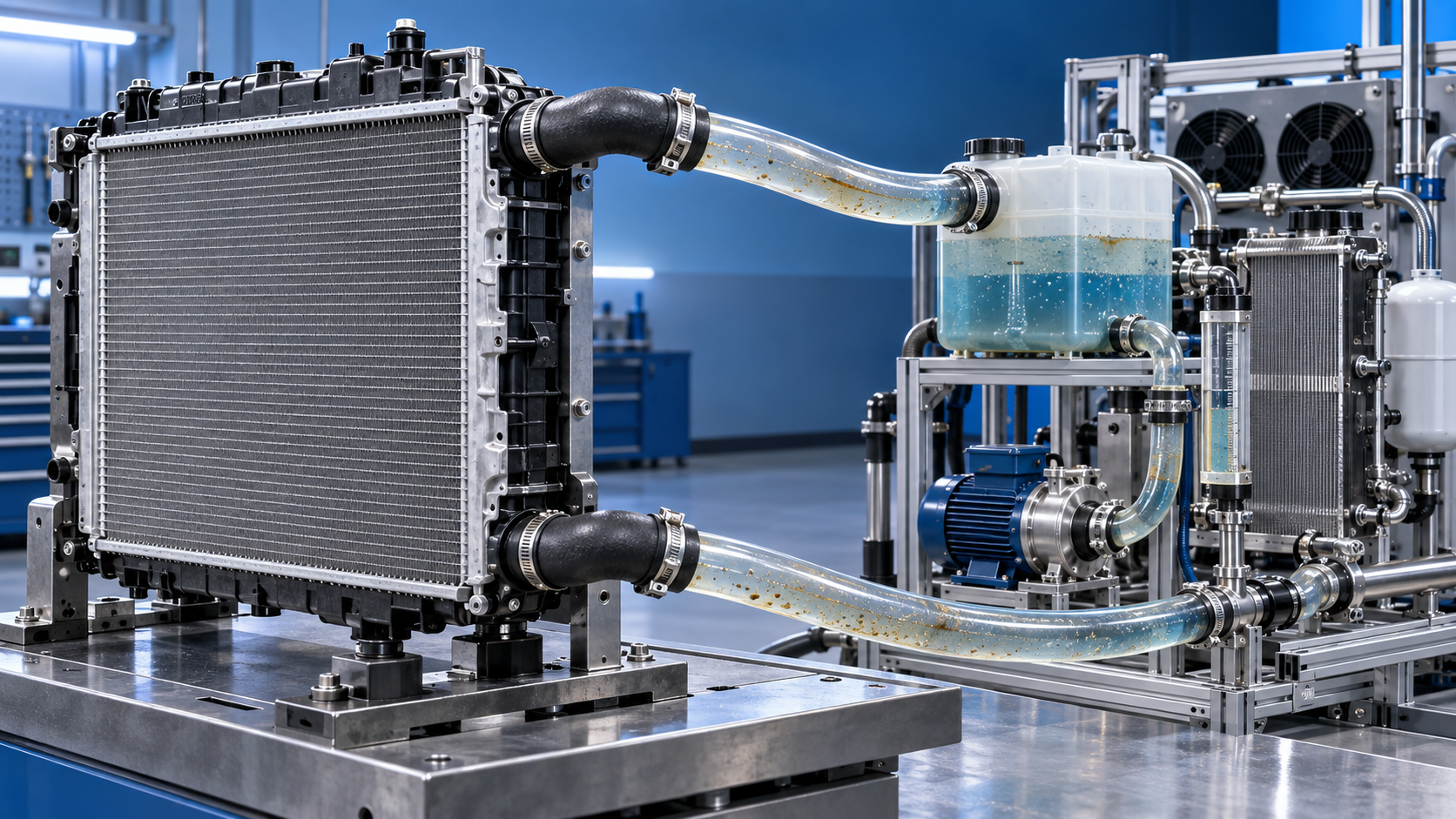
Coolant contamination can reduce a Heavy duty truck radiator’s useful life long before the core appears externally damaged. A radiator may be replaced after an overheating event, but the replacement can fail for the same reason if the contaminated coolant, deposits, or underlying mechanical fault remain in the system. For aftermarket maintenance teams, the practical question is not simply whether the coolant looks dirty. It is whether contamination has begun to restrict heat transfer, attack internal surfaces, damage seals, or indicate another fault that will continue to affect the cooling circuit.
A small amount of discoloration does not automatically justify radiator replacement. Heavy-duty cooling systems operate under high thermal load, and coolant color can change with age. The concern rises when color change is accompanied by suspended solids, oily residue, gel-like material, scale, repeated coolant loss, elevated operating temperature, or uneven temperature across the radiator core. Those signs point to a system condition that needs to be corrected before a new radiator is installed.
Why contaminated coolant shortens radiator life
A radiator depends on clean, stable coolant flow through narrow internal tubes. Heat moves from the coolant into the tube walls, then through the fins to the surrounding air. Contamination interferes with this process in several ways at once. Deposits reduce the coolant’s contact with the metal surface, corrosion weakens internal passages, and restricted flow can create local hot spots that put extra pressure on seams, tanks, hoses, and the water pump.
The service-life effect is often cumulative. A radiator can continue to operate while deposits build slowly, especially when the vehicle spends much of its time under light load. Under long climbs, hot weather, towing, construction-site work, or stop-and-go operation, the reduced cooling margin becomes more visible. The operator may report intermittent overheating rather than a permanent temperature problem. That pattern is easy to misread as a thermostat or fan issue, even though the radiator core has already lost part of its heat-rejection capacity.
Contamination also matters because modern coolant chemistry is designed to protect several materials at the same time: aluminum, steel, cast iron, soldered joints, elastomers, and sometimes plastic tanks. When the inhibitor package is depleted, diluted, or mixed with an incompatible coolant formulation, corrosion protection becomes less reliable. The result may be internal pitting, oxide particles, scaling, or deposit formation. These materials circulate through the system and can settle in low-flow areas of the radiator.
Contamination does not always look dramatic
Maintenance decisions should not rely on coolant appearance alone. Bright-colored coolant can still have depleted protection, while darker coolant may be serviceable if testing shows the chemistry remains within the vehicle manufacturer’s requirements. Visual inspection is useful for identifying obvious abnormal conditions, but it does not replace checking concentration, freeze protection, pH where applicable, and the presence of oil, solids, or incompatible fluid.
The most damaging contaminants are often introduced gradually. Repeated top-ups with untreated water increase mineral content. A hose repair may lead to filling with a different coolant type. A previous overheating event may oxidize coolant or accelerate additive depletion. A neglected reservoir cap can allow air to enter or reduce pressure control. Each issue may seem minor in isolation, but together they shorten the operating window for the radiator and other cooling-system components.
What the contamination pattern can tell a technician
The appearance and location of deposits can help narrow the diagnosis. The aim is not to make conclusions from one symptom, but to connect inspection findings with the vehicle’s operating history and cooling-system condition.
An oily coolant condition deserves special attention. Flushing the radiator without addressing the source of oil contamination can leave a film on internal surfaces and throughout the heater circuit, expansion tank, hoses, and water passages. Oil also affects rubber components and can cause hoses to soften or swell. In these cases, a partial drain-and-refill is rarely enough. The system must be cleaned according to the vehicle and chemical supplier’s approved procedure, then checked again after operation.
Rust-colored coolant creates a different risk. Loose corrosion products may initially move through the system and later accumulate in the radiator core. If a new core is fitted into a system that still contains corrosion debris, the new unit may suffer reduced flow shortly after installation. Replacing only the visibly affected radiator can turn a contamination problem into an early warranty dispute.
Separate a restricted radiator from other overheating causes
Contamination can damage a radiator, but it is not the only reason a truck overheats. Before deciding that the core has reached the end of its service life, inspect the external airflow path and test the rest of the system. Dirt packed between the radiator, charge-air cooler, condenser, and oil cooler can produce symptoms similar to internal blockage. So can a weak fan clutch, an electronically controlled fan fault, an incorrect thermostat, a collapsing suction hose, poor water-pump performance, or a pressure cap that cannot maintain the specified system pressure.
Temperature comparison is particularly useful when done carefully. A healthy radiator should show a meaningful temperature reduction from inlet to outlet when the engine is operating under a load that requires cooling. However, a large temperature difference alone does not prove that the radiator is functioning well. If coolant flow is restricted, the outlet may be much cooler simply because too little coolant is moving through parts of the core. Comparing temperatures across the face of the radiator can reveal uneven cooling zones that suggest plugged tubes or poor airflow distribution.
External inspection should include the fin surface, but also the space between heat exchangers. A core can look clean from the front while debris is trapped behind the condenser or charge-air cooler. Bent fins, mud, insects, oil mist, and improperly applied cleaning pressure can all reduce airflow. High-pressure washing at an incorrect angle may fold fins and create another restriction. Cleaning should follow the core manufacturer’s guidance and should remove debris without deforming the fin structure.
A pressure test remains important when coolant contamination and coolant loss occur together. A slow leak can draw air into the system during cool-down, increase oxidation, and create repeated low-level operation. Air pockets reduce heat transfer and may cause localized boiling near cylinder-head passages or within the radiator. The visible leak may be minor, but the operating consequence can be significant on a heavily loaded truck.
A practical response when contamination is found
The maintenance sequence should protect the replacement part as well as restore current cooling performance. Draining the old coolant is only the first step. The appropriate depth of cleaning depends on the contaminant, the severity of the deposits, and the system design.
- Record the coolant condition before draining: color, odor, visible solids, oil film, reservoir condition, and any evidence of prior mixed fluids.
- Inspect for the source of contamination, including cooler failures, corrosion sources, poor-quality top-up water, seal failures, and incorrect service practices.
- Assess radiator flow and temperature distribution alongside fan operation, thermostat behavior, pressure retention, and external airflow.
- Select a flushing method compatible with the vehicle’s metals, seals, and coolant specification. Aggressive chemicals can create new problems if used without control.
- Flush related circuits where contamination may remain, such as the heater circuit, expansion tank, hoses, and auxiliary coolers where applicable.
- Refill with the specified coolant formulation at the correct concentration, using appropriate water quality where the coolant is not supplied pre-mixed.
- Bleed air correctly, verify pressure-cap function, and confirm stable operating temperature under a meaningful load condition.
Flushing has limits. It can remove loose debris and some deposits, but it cannot reliably restore a core with severe internal corrosion, collapsed tubes, extensive scale, or persistent oil fouling. A chemical flush can also dislodge material that then blocks another passage. When deposits are heavy, the system needs closer evaluation before deciding whether to retain the radiator. The cost of repeated flushing, downtime, and a second overheating event may exceed the cost of replacing a compromised core after the contamination source has been removed.
Replacement decisions should include fitment and system cleanliness
When a radiator must be replaced, fitment is more than matching the overall width and height. Core thickness, tube layout, mounting points, hose connections, transmission or oil-cooler provisions, fan clearance, and airflow package all affect whether the replacement will perform correctly. A part with the wrong core specification can create a cooling shortfall even when it installs without obvious difficulty.
The same discipline applies across different vehicle segments. For example, a replacement listing such as XD922 RADIATOR FOR VOLKSWAGEN identifies a specific application through its XD922 and 2TG121253 references, with a 796 x 660 x 56 mm core. Those identifiers are useful starting points, but they do not replace verification of the complete vehicle application and cooling-system configuration. In heavy-duty service, this check is especially important because similar-looking radiators may be built for different duty cycles, mounting arrangements, or auxiliary cooling requirements.
Before installation, the technician should also confirm that no residual debris remains in the hoses, tank, water pump inlet, or connecting pipes. A new Heavy duty truck radiator installed into a contaminated circuit may appear to solve the immediate overheating complaint, then develop restricted flow or corrosion much earlier than expected. Where oil contamination was present, replacing affected rubber components may be justified if swelling, softening, or material breakdown is visible.
Maintenance habits that preserve the next radiator
The best prevention is controlled coolant management rather than frequent reactive top-ups. Use the coolant type specified for the engine and do not assume that similar color means compatible chemistry. Avoid mixing products unless their compatibility is explicitly established. Keep a service record of coolant changes, additions, concentration checks, and cooling-system repairs; this makes later diagnosis far easier when the vehicle returns with overheating or coolant loss.
Water quality deserves equal attention. Minerals in unsuitable water can create scale that slowly reduces heat transfer, particularly in equipment exposed to high temperatures and long service intervals. When a coolant concentrate requires dilution, use water that meets the coolant or vehicle manufacturer’s requirements. Pre-mixed coolant can reduce one source of variation, provided it matches the required formulation.
Finally, investigate temperature changes early. A truck that begins running hotter under load, needs more frequent top-ups, or develops an unexplained coolant color change is giving the maintenance team an opportunity to correct the problem before the radiator becomes the most expensive symptom. Clean coolant alone will not compensate for a failing fan, poor airflow, or a leaking combustion-gas path. But a clean, correctly maintained cooling system gives the radiator the conditions it needs to provide its intended service life.