



Choosing a Heavy duty truck radiator for high-ambient fleets
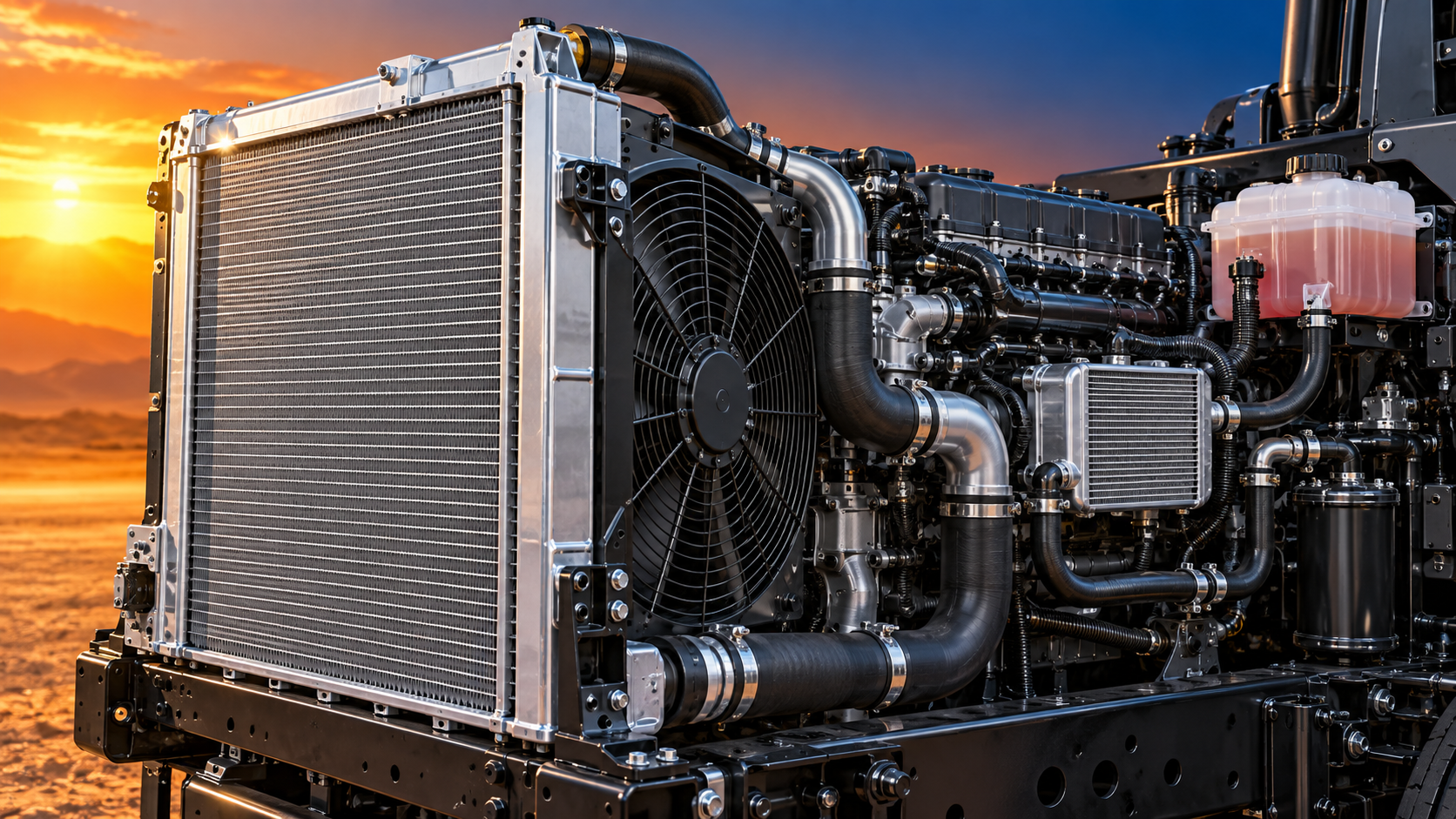
For technical evaluators managing fleets in high-ambient conditions, selecting the right Heavy duty truck radiator is not a routine replacement decision. It is a reliability decision that affects engine protection, fuel efficiency, driver confidence, service intervals, and vehicle availability. When trucks work through long summer routes, slow urban traffic, steep grades, dusty job sites, or high-load haulage cycles, the cooling system has little margin for error.
A radiator that performs adequately in moderate weather may struggle once ambient temperatures rise and airflow becomes restricted. The result is not always an immediate breakdown. More often, the warning signs appear gradually: rising coolant temperatures on climbs, frequent fan engagement, coolant loss, power derating, higher maintenance attention, or repeat complaints from drivers. A sound selection process should look beyond outside dimensions and part-number matching to determine whether the radiator can reject heat consistently under the fleet’s real operating conditions.
Start with the thermal duty, not the catalog listing
The first question is not “Which radiator fits this truck?” It is “What heat load must this vehicle control at its most demanding operating point?” High ambient operation changes the entire cooling equation. As outside air temperature rises, the temperature difference between hot coolant and incoming air becomes smaller. The radiator therefore has less natural ability to transfer heat, precisely when the engine, transmission, charge-air system, and air-conditioning system may all be producing or adding more thermal load.
Technical evaluators should define the duty cycle before comparing radiator designs. Useful inputs include:
- Typical and peak ambient temperature, including heat-soak periods after idling.
- Gross combination weight, payload variation, route grade, and average vehicle speed.
- Engine calibration, power rating, towing use, and auxiliary loads.
- Whether the truck operates in stop-start traffic, mines, ports, construction sites, or open-road transport.
- Air-conditioning demand and the condition of the condenser, charge-air cooler, fan, and shrouding.
- Dust, chaff, insects, road debris, salt exposure, and wash-down practices.
This is especially important for fleets that experience a mixture of highway running and low-speed work. At highway speed, ram air may support cooling performance. In a queue, at a loading bay, or while climbing slowly under load, the system becomes heavily dependent on fan performance and the efficiency of the entire cooling pack. A heavy-duty radiator should be evaluated as part of that system rather than as an isolated heat exchanger.
Core geometry determines more than cooling capacity
Core size matters, but it is only one part of the assessment. A larger core may offer more frontal area or coolant volume, yet its benefit can be lost if fin density is too restrictive, tube passages do not match the required coolant flow, or the fan cannot pull enough air through a tightly packed module. Conversely, a core optimized solely for low air resistance may not provide enough heat-transfer surface for prolonged high-load operation.
Ask suppliers for the core construction details that relate directly to duty: tube width and arrangement, fin profile, fin pitch, core thickness, header design, and the intended airflow direction. Multi-row concepts are not automatically superior; modern wider-tube designs can provide effective heat transfer with a different pressure-drop profile. What matters is the balance between coolant-side flow, air-side resistance, heat-transfer area, and packaging constraints.
For high-ambient fleets, it is wise to distinguish between a radiator that can handle a brief temperature spike and one that can stabilize temperatures during repeated thermal cycles. The latter is more relevant to fleet uptime. A well-matched core should recover after a climb or idle event without leaving the cooling system operating at the edge of its control range for the rest of the shift.
Airflow is often the hidden constraint
Many overheating investigations focus on coolant circulation while overlooking the air path. Yet the radiator can only reject heat when air passes through its fins in sufficient volume and with minimal bypass. Gaps around the fan shroud, damaged seals between heat exchangers, a contaminated condenser face, bent fins, or an incorrectly specified fan can make a capable radiator appear inadequate.
In stacked cooling modules, the radiator may receive air that has already been warmed by the air-conditioning condenser and charge-air cooler. The sequence, spacing, and cleanliness of these components should be included in the evaluation. A replacement unit with nominally correct dimensions but a different fin configuration can alter pressure drop across the full stack and reduce air movement where it is most needed.
Before approving a Heavy duty truck radiator, confirm that its mounting interfaces support the original shroud, seals, fan clearance, and airflow path. Fitment should not mean merely that the bolts line up. It should mean the installed assembly preserves the designed air-management strategy.
Material choices should reflect the route environment
Most modern truck radiators use aluminum cores because aluminum provides an effective balance of heat transfer, weight, and manufacturability. However, the material discussion should not end there. The reliability of an aluminum radiator depends on tube and fin quality, braze integrity, header construction, tank attachment, vibration management, and corrosion protection across the cooling system.
Plastic tanks with aluminum cores are common in many applications and can perform well when the tank material, crimp geometry, gasket design, and operating pressure are correctly matched. In severe-duty fleets, evaluators should pay close attention to areas where thermal expansion, vibration, and pressure cycling concentrate stress: tank-to-header joints, mounting brackets, hose necks, drain points, and transmission cooler connections where applicable.
Environmental exposure also changes the decision. Coastal routes and winter road salt increase external corrosion risk. Construction and agricultural work can pack fine debris into fins and create moisture-retaining deposits. Poor coolant maintenance can introduce internal corrosion, scale, or electrochemical damage. A radiator cannot compensate for unsuitable coolant chemistry, mixed coolant types, neglected grounding, or excessive system pressure; it can only tolerate these conditions for a limited time.
Pressure resistance and fatigue deserve a practical review
High ambient operation usually means higher sustained temperatures and more frequent pressure cycling. These conditions place extra demands on every joint and sealing surface. A technical review should therefore include the radiator’s stated pressure capability, test approach, and traceability, but should also consider the truck’s expansion tank cap, thermostat behavior, water pump condition, and any history of overpressure events.
A recurring mistake is replacing a failed radiator without identifying why it failed. A split tank may point to age-related fatigue, but it may also indicate a sticking pressure cap, combustion gas entering the coolant circuit, blocked passages, or an installation issue that left the unit under stress. If the root cause remains, even a stronger replacement component may suffer the same fate.
Vibration is another quiet source of failures. Heavy trucks do not operate on laboratory roads. Cab movement, chassis flex, rough surfaces, and unsupported hoses can transfer load into the radiator. Check whether upper and lower mounts are correct, isolators are in good condition, and hoses have adequate freedom of movement. A radiator should sit securely without being rigidly forced into a distorted support frame.
Fitment validation must go beyond OE number cross-reference
Part-number cross-referencing is useful, but it is not a complete engineering validation. Truck platforms may share a basic chassis while differing in engine output, cooling-pack layout, automatic transmission equipment, fan strategy, emissions configuration, or market-specific accessories. These differences can change radiator requirements even when external dimensions appear close.
A disciplined fitment check should compare:
- Core width, height, thickness, and mounting points.
- Inlet and outlet location, diameter, angle, and hose connection type.
- Tank geometry, filler arrangement, sensor ports, drain design, and overflow connections.
- Integrated oil or transmission cooler configuration, if fitted.
- Shroud attachment, fan clearance, and clearance to adjacent charge-air or condenser components.
- Cooling capacity requirement for the specific engine and operating package.
Dimensional discipline also applies to other heat exchangers. For example, when assessing related cooling components, the INTERCOOLER FOR TG1270001070 HILUX VIGO CHAMP is identified with a 275 × 202 × 50 core size and tank dimensions of 321 × 69/81. Those figures help establish physical compatibility, but they should always be read alongside airflow, pressure-drop, connection, and vehicle-application requirements. The same principle is even more critical for heavy-truck cooling systems, where a nominal size match does not prove thermal suitability.
How to compare supplier proposals objectively
When several radiators appear suitable, avoid making the decision solely on unit cost or stated material. Build a comparison sheet that links the proposal to fleet risk. Include application coverage, core design details, pressure-test information, packaging protection, warranty terms, traceability, lead time, and availability of technical support. If a supplier cannot clarify the configuration or provide consistent identification data, that uncertainty becomes a maintenance risk once the part is in the field.
Manufacturing capability is relevant because cooling components depend on process control: fin formation, tube assembly, brazing, tank crimping, leak testing, and final inspection all influence long-term consistency. Liaocheng Xinde Auto Parts Co., Ltd., established in 2018, develops and supplies radiators, intercoolers, construction machinery radiators, and related cooling components for heavy trucks and new-energy radiator modules. For evaluators, the useful conversation is not a broad claim of quality; it is whether the supplier can discuss the selected radiator’s application, construction, inspection approach, and expected installation conditions with enough precision to support a fleet decision.
Requesting samples for visual and dimensional inspection can be worthwhile, particularly for recurring fleet purchases. Inspect fin condition, weld or braze appearance where visible, tank alignment, port finish, mounting accuracy, protective packaging, and labeling. A radiator that arrives with crushed fins or poorly protected connections may create avoidable problems before installation even begins.
Commissioning can reveal problems before they become downtime
After installation, the system should be filled with the specified coolant mixture, properly bled, and inspected at operating temperature. Verify hose routing, fan clearance, shroud sealing, coolant level stability, and absence of leaks after the first heat cycle. On a representative road test, monitor coolant temperature behavior under load rather than judging performance during a short idle check.
For high-ambient fleets, it is useful to establish a baseline: ambient temperature, load, route condition, coolant temperature trend, fan engagement behavior, and any derate events. This gives maintenance teams a reference when seasonal conditions change or when the cooling pack begins to accumulate debris. The goal is not to chase a single temperature number, since control strategies vary by engine, but to recognize abnormal trends early.
A better purchase decision protects the whole fleet system
The right Heavy duty truck radiator is one that fits the vehicle correctly, works with the existing airflow system, withstands pressure and vibration, and provides enough thermal margin for the fleet’s hottest, slowest, most heavily loaded day—not merely for a mild test drive. Technical evaluators who define the duty cycle, examine core and airflow design, validate interfaces, and review supplier evidence will make fewer reactive replacements.
In high-ambient service, cooling capacity is not a comfort feature. It is the margin that keeps an engine productive when the road, weather, and workload leave little room for compromise.